
Applications of Derivatives Class 12: The chapter Application of Derivatives in Class 12 Mathematics is one of the most practical and conceptually rich chapters in the calculus section. After understanding the basics of derivatives in the previous chapter, this chapter focuses on how differentiation is used to solve real-life mathematical problems. It provides tools to analyze the behavior of functions, find their extreme values, and understand their rate of change.
 Join Telegram
 Join WhatsApp
The key areas covered include rate of change of quantities, increasing and decreasing functions, tangents and normals to curves, approximations, and maxima and minima. These topics are not just essential for board exams but also have great significance in competitive exams like JEE, CUET, and engineering entrance tests.
One of the most useful applications is in optimization problems—where we need to find the maximum profit, minimum cost, or most efficient design. This is highly relevant for fields such as physics, economics, and engineering.
With the help of graphical understanding and proper application of the first and second derivative tests, students learn how to approach real-world scenarios mathematically. This chapter enhances both problem-solving and analytical skills, making it a crucial part of Class 12 Math’s curriculum.
Preview of Chapter 6: Application of Derivatives – Class 12 NCERT Solutions PDF | Handwritten Notes Free Download
Images of Chapter 6: Application of Derivatives – Class 12 NCERT Solutions PDF | Handwritten Notes Free Download

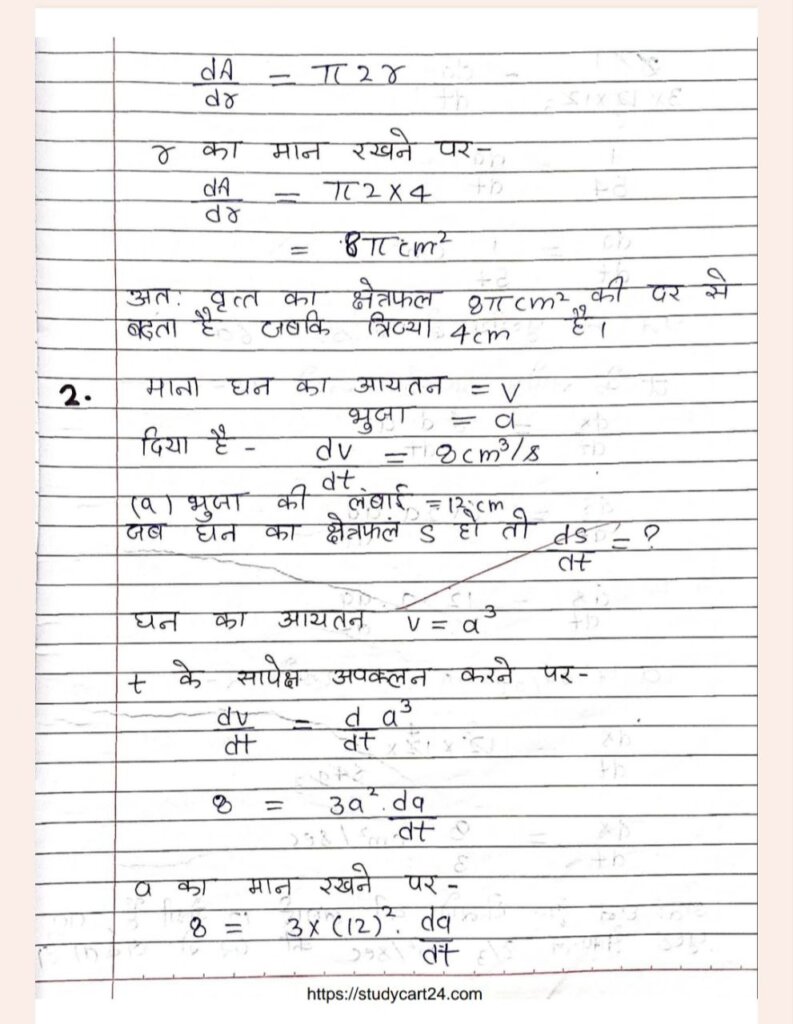

Related Free Notes from Studycart24.com of Class 12
- Class 12 Computer Science Notes PDF in English Free Download
- Class 12 Geography Notes: Download Free PDF of All Chapters in English
- Class 12 Physics Handwritten Notes in English PDF Download
- Class 12 Biology Handwritten Notes PDF Free Download- StudyCart24.com
- Class 12 Business Studies Notes: FREE Notes Chapter 1 to 12
- Complete Class 12 Chemistry Notes PDF with All Chapters for Free
🙏 Support Our Work
We work very hard to create quality handwritten notes to support your learning journey. Every page is the result of hours of dedication and care. If you find our efforts valuable, please consider supporting us. Even a small contribution of ₹5, ₹10, ₹50, or ₹100 — whatever feels right to you — can make a big difference. Your support helps us continue this platform and keep the notes accessible to everyone. Donate securely via PhonePe – your kindness truly means a lot.

UPI ID:
(Tap to copy)
Please Donate ₹5, ₹10, ₹50, ₹100 or whatever feels right to you.
Suggested Notes Links from Amazon Related to Class 12 Math’s Handwritten Notes
Arihant All in One Mathematics Class 12 for CBSE Exams 2025-26 | Revised Edition as per latest syllabus | Simplified Theory, All Types of Exam Pattern Questions, CBQs, MCQs, A-R, Case Based, Sample Question Papers, Mind Maps, Topic & Chapter Exercises, Periodic Tests & Activities

Oswaal CBSE & NCERT One for All Class 12 Mathematics (For 2026 Exam)
Disha WINR Series CBSE Class 12 Mathematics Chapter-wise Objective & Subjective Question Bank| NCERT, Exemplar, PYQs & SQP |Competency (CFPQ) Questions| Book by Ushank Ghai For 2026 Exam
📘 Definition of Application of Derivatives
“Application of Derivatives” refers to the use of the derivative of a function in solving various real-world and mathematical problems. It involves applying the concept of differentiation to analyze the behavior of functions and make informed decisions based on their rates of change.
In simple terms, it means using derivatives to:
- Calculate the rate of change of quantities,
- Identify increasing or decreasing behavior of functions,
- Find the tangent or normal to a curve at a given point,
- Make approximations,
- And determine the maximum or minimum values of functions (optimization).
These applications are widely used in physics, economics, biology, engineering, and many other fields where analyzing change or optimizing performance is essential
Key Features of Chapter 6: Application of Derivatives – Class 12 NCERT Solutions PDF | Handwritten Notes Free Download
- Subject: Maths (Chapter 6: Application of Derivatives – Class 12 NCERT )
- Language : Hindi
- Total pages : 177
- File size: 32.7 MB
- Format : PDF
- Well structured and easy to understand
- Includes importance formulas and definitions
- Covers all NCERT syllabus topics
- Useful for quick revision before exam
📘 Chapter 6: Application of Derivatives – Class 12
🧾 Important Definitions
- Derivative
The derivative of a function measures the rate at which the function value changes as its input changes. It is denoted by f′(x)f'(x)f′(x) or dydx\frac{dy}{dx}dxdy. - Rate of Change
The rate of change of a quantity describes how one quantity changes in relation to another. Mathematically, it is expressed as a derivative. - Increasing Function
A function f(x)f(x)f(x) is said to be increasing on an interval if f′(x)>0f'(x) > 0f′(x)>0 for all xxx in that interval. - Decreasing Function
A function f(x)f(x)f(x) is said to be decreasing on an interval if f′(x)<0f'(x) < 0f′(x)<0 for all xxx in that interval. - Tangent to a Curve
A straight line that touches a curve at a point and has the same slope as the curve at that point. - Normal to a Curve
A line perpendicular to the tangent at a given point on the curve. - Approximation
Using derivatives, a function’s value near a point can be approximated using linear approximation:
f(x+h)≈f(x)+hf′(x)f(x + h) \approx f(x) + h f'(x)f(x+h)≈f(x)+hf′(x) - Maxima and Minima
The maximum or minimum value of a function occurs at points where the first derivative is zero and changes sign. These are critical for optimization problems. - Critical Point
A point on the graph of a function where the derivative is either zero or undefined. - Optimization
The process of finding the best (maximum or minimum) value of a function under given constraints.
🧠 How to Prepare for Chapter 6: Application of Derivatives – Class 12
To master Application of Derivatives, you need a strong understanding of concepts + consistent practice. Here’s a step-by-step preparation strategy:
✅ 1. Revise Basic Derivatives
- Revise all standard derivatives and rules (product, quotient, chain rule).
- Be fluent in differentiation techniques — this is your foundation.
✅ 2. Understand Each Concept Clearly
- Rate of Change – Practice word problems involving physical quantities.
- Increasing/Decreasing Functions – Learn how to test intervals using the first derivative.
- Tangents & Normals – Practice questions on equations of lines to curves.
- Approximation – Learn linear approximation using derivatives.
- Maxima and Minima – Focus on first and second derivative tests with sign charts.
✅ 3. Solve NCERT + Exemplar Problems
- Start with NCERT examples and exercises.
- Move on to NCERT Exemplar for slightly higher difficulty.
✅ 4. Use Graphs for Visualization
- Try to sketch graphs of functions to understand increasing/decreasing behavior and turning points.
✅ 5. Practice PYQs & Miscellaneous Problems
- Solve Previous Year Questions (PYQs) from CBSE boards.
- Try miscellaneous exercise at the end of the chapter.
✅ 6. Make a Formula Sheet
- Keep all important formulas on one page.
- Revise them regularly before solving problems.
✅ 7. Take Mock Tests & Time-Bound Practice
- Solve 2–3 questions daily under exam conditions.
- Focus on accuracy and step-by-step presentation as per board marking scheme.
📚 Chapters / Subtopics Included in
Chapter 6: Application of Derivatives – Class 12
| S.No. | Subtopic Title | Description |
|---|---|---|
| 1. | Rate of Change of Quantities | Use of derivatives to find how one quantity changes w.r.t. another. |
| 2. | Increasing and Decreasing Functions | Determining intervals where a function is increasing or decreasing. |
| 3. | Tangents and Normals | Finding equations of tangents and normals to curves at given points. |
| 4. | Approximations | Using linear approximation formula to estimate function values. |
| 5. | Maxima and Minima | Finding local maximum and minimum values using derivative tests. |
| 6. | First Derivative Test | Technique to identify maxima or minima by analyzing sign of f′(x)f'(x)f′(x). |
| 7. | Second Derivative Test | Advanced method using f′′(x)f”(x)f′′(x) to classify critical points. |
| 8. | Application-Based Problems | Real-life optimization problems like minimizing cost, maximizing area, etc. |
Why Are These Handwritten Notes Special for You?
- Neat & Clean Handwriting
- आसान भाषा और सुंदर लेखन, जिससे समझना और याद रखना आसान हो।
- Concept Clarity
- हर टॉपिक को “क्यों?” और “कैसे?” के साथ समझाया गया है।
- Exam-Oriented Content
- CBSE Board और JEE जैसे एग्जाम्स के हिसाब से महत्वपूर्ण प्रश्न और शॉर्ट ट्रिक्स शामिल हैं।
- Chapter-Wise Formula Sheets
- हर अध्याय के अंत में सभी जरूरी सूत्रों का एक पेज में सारांश।
- Useful for Competitive Exams
- JEE Main, NDA, CUET आदि प्रतियोगी परीक्षाओं के लिए भी उपयोगी।
- Well-Labelled Diagrams & Graphs
- जहां जरूरी है, वहां चार्ट और ग्राफ़ के माध्यम से समझाया गया है।
- Time-Saving Revision
- कम समय में पूरे चैप्टर को कवर करने के लिए संक्षिप्त लेकिन सटीक जानकारी।
- Topic-Wise Separation
- हर टॉपिक को हेडिंग्स, बॉक्स और उदाहरणों के साथ अलग-अलग तरीके से प्रस्तुत किया गया है।
- Prepared by Toppers & Experts
- ये नोट्स अनुभवी शिक्षकों और टॉपर्स की सहायता से तैयार किए गए हैं।
- Student-Tested & Approved
- हजारों छात्रों ने इन नोट्स को उपयोगी और प्रभावशाली माना है।
✅ Top 10 Benefits of Using Handwritten Notes –Chapter 6: Application of Derivatives – Class 12
| S.No. | Benefit | Description |
|---|---|---|
| 1 | Better Concept Retention | Writing helps remember formulas and concepts more effectively. |
| 2 | Enhanced Focus & Concentration | Minimizes distractions and improves attention span. |
| 3 | Personalized Learning | Notes can be customized with color codes, diagrams, and shortcuts. |
| 4 | Quick Revision Tool | Acts as a summary for fast last-minute exam revision. |
| 5 | Exam-Oriented Content | Includes only the most relevant and important topics and examples. |
| 6 | Improves Problem-Solving Speed | Regular use improves speed and accuracy in numerical questions. |
| 7 | Boosts Writing Practice | Enhances written presentation, important for board exam marking. |
| 8 | Easy to Revise Anytime | No device or internet required; revise anywhere, anytime. |
| 9 | Highlights Common Mistakes | Helps track and avoid errors often repeated in practice. |
| 10 | Acts as a Lifesaver Before Exams | Great for full syllabus revision in a short time before exams. |
📌 Important Topics – Chapter 6: Application of Derivatives – Class 12 Maths
These are the most exam-relevant and concept-heavy areas you must focus on:
| S.No. | Topic Name | Importance / Usage in Exams |
|---|---|---|
| 1 | Rate of Change of Quantities | Used in real-life word problems involving speed, area, volume, etc. |
| 2 | Increasing and Decreasing Functions | Key for identifying function behavior; 3–4 mark questions common. |
| 3 | Tangents and Normals to a Curve | Conceptual + calculation-based questions frequently asked. |
| 4 | Approximations | Linear approximation formula; often asked as 1 or 2 mark question. |
| 5 | Maxima and Minima | Most important section; used in optimization problems. |
| 6 | First Derivative Test | Step-by-step method to test increasing/decreasing/max/min points. |
| 7 | Second Derivative Test | Used to confirm maximum or minimum at critical points. |
| 8 | Application-Based Optimization | Real-world problems like maximizing area, profit, etc. (3–5 marks). |
🔢 Class 12 Math’s Important Formulas
📘 Chapter 6: Application of Derivatives – Application-Based Formulas
| S.No. | Concept | Formula / Rule |
|---|---|---|
| 1 | Derivative Definition | f′(x)=limh→0f(x+h)−f(x)hf'(x) = \lim_{h \to 0} \frac{f(x + h) – f(x)}{h}f′(x)=limh→0hf(x+h)−f(x) |
| 2 | Rate of Change | dydt=dydx⋅dxdt\frac{dy}{dt} = \frac{dy}{dx} \cdot \frac{dx}{dt}dtdy=dxdy⋅dtdx |
| 3 | Increasing Function | f′(x)>0f'(x) > 0f′(x)>0 in the interval |
| 4 | Decreasing Function | f′(x)<0f'(x) < 0f′(x)<0 in the interval |
| 5 | Stationary Point | f′(x)=0f'(x) = 0f′(x)=0 |
| 6 | Equation of Tangent | y−y1=f′(x1)(x−x1)y – y_1 = f'(x_1)(x – x_1)y−y1=f′(x1)(x−x1) |
| 7 | Equation of Normal | y−y1=−1f′(x1)(x−x1)y – y_1 = -\frac{1}{f'(x_1)}(x – x_1)y−y1=−f′(x1)1(x−x1) |
| 8 | Approximation Formula | f(x+h)≈f(x)+h⋅f′(x)f(x + h) \approx f(x) + h \cdot f'(x)f(x+h)≈f(x)+h⋅f′(x) |
| 9 | First Derivative Test | If f′(x)f'(x)f′(x) changes sign at x=cx = cx=c, it’s a max/min point |
| 10 | Second Derivative Test | If f′(c)=0f'(c) = 0f′(c)=0 and f′′(c)<0f”(c) < 0f′′(c)<0 → max, and f′′(c)>0f”(c) > 0f′′(c)>0 → min |
| 11 | Maximum/Minimum Value | Occurs where f′(x)=0f'(x) = 0f′(x)=0 and change of sign or use second derivative test |
| 12 | Optimization Problems | Form a function → Differentiate → Find critical points → Analyze |
❓ FAQs on Class 12 Math’s Handwritten Notes PDF Download
Yes, the notes strictly follow the Class 12 NCERT and CBSE syllabus.
Yes, complete chapter-wise notes are available, including examples and exercises.
Most handwritten notes include solved NCERT and selected exemplar problems.
Yes, if you combine them with practice of NCERT exercises and PYQs.
Definitely. They cover fundamental concepts that are useful for JEE, CUET, NDA, etc.
Yes, the PDFs are printable and can be used for offline study.
Yes, where needed, visuals are provided for better conceptual clarity.
Some notes include tips, tricks, and shortcuts for quick revision.
Notes are based on the latest syllabus and updated annually or as per board changes.
Yes, you can request/download notes chapter-wise for easy revision.
🧠 Class 12 Maths Preparation Tips (Short & Effective)
| S.No. | Tip | Description |
|---|---|---|
| 1. | Start with NCERT | Solve every example and exercise thoroughly—this is your base. |
| 2. | Make a Formula Sheet | Keep all important formulas chapter-wise in one place for daily revision. |
| 3. | Understand Concepts, Don’t Cram | Focus on logic and derivation behind each formula or rule. |
| 4. | Solve PYQs (Last 5 Years) | Analyze question patterns and repeated topics. |
| 5. | Practice Daily (1–2 Hours) | Consistency is key; solve 10–15 questions daily from different chapters. |
| 6. | Target Weak Areas First | Focus more time on chapters you find difficult (e.g., Probability, AOD). |
| 7. | Use Handwritten Notes | Revise faster using clean, well-organized notes before exams. |
| 8. | Take Timed Practice Tests | Practice writing full-length tests to improve speed and accuracy. |
| 9. | Use Graphs & Visuals | Especially in Calculus, visual understanding helps in solving faster. |
| 10. | Revise Weekly | Revise all completed chapters every week to retain concepts better. |
❌ Avoid These Common Mistakes in Class 12 Math’s
| S.No. | Mistake | Why It Hurts & How to Avoid It |
|---|---|---|
| 1. | Skipping NCERT Exercises | NCERT forms the base for board exams; solve all examples and exercises. |
| 2. | Ignoring Theoretical Concepts | Just memorizing formulas won’t help—understand the ‘why’ behind them. |
| 3. | Forgetting Units in Final Answers | Especially in AOD and applications, units are often part of marking. |
| 4. | Sign Mistakes in Derivatives/Equations | Be extra careful with plus/minus signs, especially in calculus. |
| 5. | Misusing Identities or Formulas | Memorize formulas correctly and understand their conditions. |
| 6. | Not Showing Steps in Board Exams | Step-marking matters in CBSE—write clean, stepwise solutions. |
| 7. | Skipping Graphs in Calculus/Relations | Graphs help visualize and support your answers—don’t avoid them. |
| 8. | Not Practicing Word Problems | Application-based problems are scoring but need practice to master. |
| 9. | Leaving Questions Unattempted | Attempt all questions—even partial steps can earn marks. |
| 10. | Last-Minute Cramming Without Revision | Don’t wait till the end—revise weekly to avoid panic and confusion. |
📋 Summary Table – Chapter 6: Application of Derivatives – Class 12 Maths
This table gives you a quick overview of all key concepts, formulas, and uses in one place:
| S.No. | Topic / Concept | Key Formula / Rule | Application / Use Case |
|---|---|---|---|
| 1. | Derivative | f′(x)=limh→0f(x+h)−f(x)hf'(x) = \lim_{h \to 0} \frac{f(x+h)-f(x)}{h}f′(x)=limh→0hf(x+h)−f(x) | Measures rate of change |
| 2. | Rate of Change | dydt=dydx⋅dxdt\frac{dy}{dt} = \frac{dy}{dx} \cdot \frac{dx}{dt}dtdy=dxdy⋅dtdx | Physics, economics, geometry |
| 3. | Increasing Function | f′(x)>0f'(x) > 0f′(x)>0 | Function rises as x increases |
| 4. | Decreasing Function | f′(x)<0f'(x) < 0f′(x)<0 | Function falls as x increases |
| 5. | Tangents | y−y1=f′(x1)(x−x1)y – y_1 = f'(x_1)(x – x_1)y−y1=f′(x1)(x−x1) | Slope of curve at a point |
| 6. | Normals | y−y1=−1f′(x1)(x−x1)y – y_1 = -\frac{1}{f'(x_1)}(x – x_1)y−y1=−f′(x1)1(x−x1) | Perpendicular to tangent at a point |
| 7. | Approximation | f(x+h)≈f(x)+h⋅f′(x)f(x+h) \approx f(x) + h \cdot f'(x)f(x+h)≈f(x)+h⋅f′(x) | Estimate value near a point |
| 8. | Maxima / Minima | f′(x)=0f'(x) = 0f′(x)=0, then use 1st or 2nd derivative test | Optimization problems |
| 9. | First Derivative Test | Sign change of f′(x)f'(x)f′(x) around critical point | Determines local max/min |
| 10. | Second Derivative Test | If f′′(x)<0f”(x) < 0f′′(x)<0 → Max, If f′′(x)>0f”(x) > 0f′′(x)>0 → Min | Confirms nature of turning point |
| 11. | Optimization Applications | Build function → Differentiate → Find extreme values | Max profit, min cost, area optimization etc. |
🔚 Conclusion – Chapter 6: Application of Derivatives – Class 12 Maths
Chapter 6: Application of Derivatives is one of the most important and practical chapters in Class 12 Mathematics. It extends the concept of derivatives into real-world applications, helping students develop both analytical and problem-solving skills. From calculating the rate of change to finding maxima and minima, and from understanding the behavior of functions to solving optimization problems, this chapter plays a vital role in both academics and competitive exams like JEE, NDA, and CUET.
Students learn to apply first and second derivative tests to determine increasing/decreasing functions and local extreme values. Concepts such as tangents, normals, and linear approximations not only strengthen calculus understanding but also prepare students for advanced mathematics in higher studies.
By mastering this chapter, students build a strong foundation for real-life applications in physics, economics, engineering, and computer science. Regular practice, visual understanding through graphs, and a focus on conceptual clarity are key to scoring well in this unit.
In conclusion, Application of Derivatives is not just a chapter in your syllabus—it’s a toolkit for analyzing change, optimizing outcomes, and thinking mathematically.
Tags:-
Chapter 6: Application of Derivatives – Class 12 NCERT Solutions PDF | Handwritten Notes Free Download
Application of Derivatives Class 12
Class 12 Maths Chapter 6
NCERT Solutions Class 12 Maths
Application of Derivatives Notes
Handwritten Notes Class 12 Maths
Free PDF Maths Notes Class 12
CBSE Class 12 Maths Solutions
Application of Derivatives NCERT PDF
Derivatives Class 12 Handwritten Notes
Class 12 Maths Board Exam Preparation
Maxima and Minima Class 12
Tangents and Normals Class 12
Increasing and Decreasing Functions Class 12
NCERT Chapter 6 Maths PDF
JEE Maths Calculus Notes
Class 12 Maths Important Questions
Maths Chapter 6 Formula Sheet
CBSE Class 12 Chapter-wise Notes
Application of Derivatives Revision Notes
Class 12 Maths Free Download
Applications of Derivatives Class 12 notes
Applications of Derivatives Class 12 PDF
Class 12 Application of Derivatives Solutions
Class 12 Application of Derivatives Solutions PDF
Applications of derivatives class 12 commerce
Applications of Derivatives Class 12 miscellaneous
Applications of derivatives Class 12 Formulas
Application of Integrals Class 12

