
Chapter 10: Vector Algebra Class 12 Solutions PDF | Class 12 Maths Handwritten Notes In Hindi: Vector Algebra is one of the most important chapters in Class 12 Mathematics. It deals with physical quantities that have both magnitude and direction, known as vectors. This concept is widely used in Physics, Engineering, and many real-life applications like displacement, velocity, force, etc.
 Join Telegram
 Join WhatsApp
In this chapter, you will learn how to add vectors, subtract them, and multiply them using scalar (dot) product and vector (cross) product. These operations are crucial for solving problems related to geometry, physics, and calculus.
Mastering this chapter will not only help you in board exams but also in competitive exams like JEE, NDA, and CUET. The concepts taught here form the foundation for 3D Geometry and various physics-based applications.
📌 Key Highlights:
- Understanding Vectors and their types
- Vector Addition and Subtraction
- Scalar (Dot) Product and Vector (Cross) Product
- Step-by-step solutions to NCERT Questions
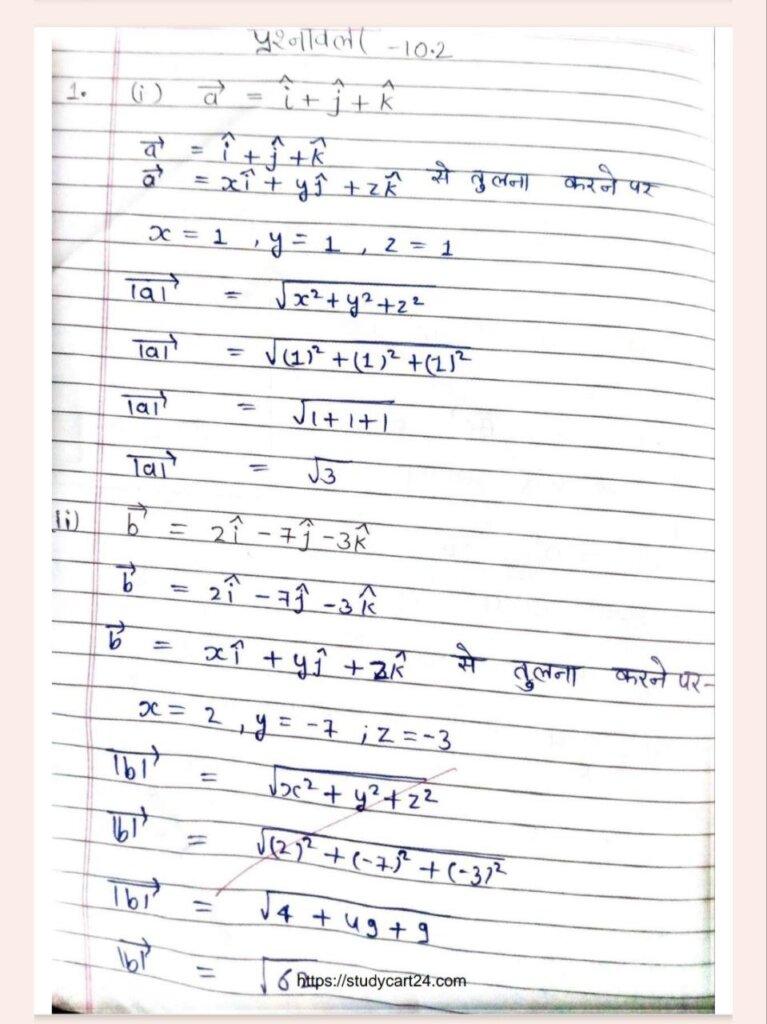
Preview of Chapter 10: Vector Algebra Class 12 Solutions PDF | Class 12 Maths Handwritten Notes
Images of NCERT Solutions for Class 12 Math’s Chapter 10 – Vector Algebra Handwritten Notes In Hindi PDF


Related Free Notes from Studycart24.com of Class 12
- Class 12 Biology Handwritten Notes PDF Free Download- StudyCart24.com
- Class 12 Business Studies Notes: FREE Notes Chapter 1 to 12
- Complete Class 12 Chemistry Notes PDF with All Chapters for Free
- Class 12 Computer Science Notes PDF in English Free Download
- Class 12 Geography Notes: Download Free PDF of All Chapters in English
- Class 12 Physics Handwritten Notes in English PDF Download
🙏 Support Our Work
We work very hard to create quality handwritten notes to support your learning journey. Every page is the result of hours of dedication and care. If you find our efforts valuable, please consider supporting us. Even a small contribution of ₹5, ₹10, ₹50, or ₹100 — whatever feels right to you — can make a big difference. Your support helps us continue this platform and keep the notes accessible to everyone. Donate securely via PhonePe – your kindness truly means a lot.

UPI ID:
(Tap to copy)
Please Donate ₹5, ₹10, ₹50, ₹100 or whatever feels right to you.
Suggested Notes Links from Amazon Related to Class 12 Math’s Handwritten Notes
MTG NCERT Textbook + Exemplar Problem Solutions Class 12 Mathematics | Complete Solutions to All Objective & Subjective Questions
Oswaal CBSE & NCERT One for All Class 12 Mathematics (For 2026 Exam)
CBSE Chapterwise Question Bank 20242011 Mathematics Class 12th
📘 Definition – Chapter 10: Vector Algebra (Class 12 Math’s)
A vector is a quantity that has both magnitude and direction. It is used to represent physical quantities such as displacement, velocity, acceleration, and force.
In contrast, a scalar is a quantity that has only magnitude and no direction (e.g., mass, temperature, time).
🔹 Basic Definitions:
- Vector: A directed line segment represented by an arrow. Example:
A⃗=a1i^+a2j^+a3k^\vec{A} = a_1\hat{i} + a_2\hat{j} + a_3\hat{k}A=a1i^+a2j^+a3k^ - Magnitude of a Vector:
∣A⃗∣=a12+a22+a32|\vec{A}| = \sqrt{a_1^2 + a_2^2 + a_3^2}∣A∣=a12+a22+a32 - Unit Vector: A vector with magnitude equal to 1.
A^=A⃗∣A⃗∣\hat{A} = \frac{\vec{A}}{|\vec{A}|}A^=∣A∣A - Zero Vector: A vector with zero magnitude and no specific direction. Denoted by 0⃗\vec{0}0
- Equal Vectors: Vectors having the same magnitude and direction.
- Position Vector: A vector that represents the position of a point with respect to the origin.
Key Features of NCERT Solutions for Class 12 Math’s Chapter 10 – Vector Algebra Handwritten Notes In Hindi PDF
- Subject: Maths (Class 12 Math’s Chapter 10 – Vector Algebra )
- Language : Hindi
- Total pages : 44
- File size: 8.1 MB
- Format : PDF
- Well structured and easy to understand
- Includes importance formulas and definitions
- Covers all NCERT syllabus topics
- Useful for quick revision before exam
10 Important Definitions From Chapter 10: Vector Algebra (Class 12 Math’s)
1. Vector
A quantity having both magnitude and direction is called a vector.
2. Scalar
A quantity having only magnitude but no direction is called a scalar (e.g., mass, time, temperature).
3. Zero Vector
A vector whose magnitude is zero is called a zero vector. It is denoted by 0⃗\vec{0}0.
4. Unit Vector
A vector whose magnitude is 1 (unity) is called a unit vector.
5. Position Vector
The vector that represents the position of a point relative to the origin is called a position vector.
6. Equal Vectors
Two vectors are equal if they have the same magnitude and are in the same direction.
7. Negative of a Vector
If a vector has the same magnitude but opposite direction, it is called the negative of that vector.
8. Collinear Vectors
Two or more vectors are called collinear if they lie on the same line or parallel lines.
9. Dot Product (Scalar Product)
The product of the magnitudes of two vectors and the cosine of the angle between them is called the dot product.
10. Cross Product (Vector Product)
The product of the magnitudes of two vectors and the sine of the angle between them in a direction perpendicular to the plane containing them is called the cross product.
How to Prepare for Chapter 10: Vector Algebra (Class 12 Math’s)
| Step | Preparation Tip |
|---|---|
| 1 | Revise basic concepts: Scalars vs Vectors, position vector, unit vector, zero vector. |
| 2 | Learn all formulas: Vector addition, subtraction, dot product, cross product. |
| 3 | Understand geometric interpretations of dot & cross product. |
| 4 | Practice NCERT examples before attempting exercises (Ex 10.1 – 10.3). |
| 5 | Create a 1-page formula sheet for quick revision. |
| 6 | Draw diagrams to visualize vector direction & orientation. |
| 7 | Solve previous year board exam questions from this chapter. |
| 8 | Attempt mixed conceptual & numerical problems for practice. |
| 9 | Revise short properties (commutative, distributive laws of vectors). |
| 10 | Dedicate 15–20 minutes daily for regular revision of formulas & key points. |
Chapter-Wise Breakdown for Class 12 Math’s Chapter 10 – Vector Algebra
Topics Covered:
- Introduction to Vectors
- Scalars vs Vectors
- Position vector, displacement vector, equal & negative vectors
- Unit vector, zero vector, collinear vectors
- Addition of Vectors
- Triangle law & parallelogram law
- Properties of vector addition
- Multiplication of a Vector by a Scalar
- Properties & applications
- Product of Two Vectors
- Scalar (Dot) Product
- Definition, formula & properties
- Geometric interpretation
- Applications (projection of a vector, angle between vectors)
- Vector (Cross) Product
- Definition, formula & properties
- Geometric interpretation
- Applications
- Scalar (Dot) Product
- Applications of Dot & Cross Product
- Finding angles between vectors
- Vector projections
- Area of triangle & parallelogram using cross product
- NCERT Exercises
- Exercise 10.1: Basics & operations on vectors
- Exercise 10.2: Dot product & its applications
- Exercise 10.3: Cross product & its applications
Why These Handwritten Notes Are Special for You? Class 12 Math’s Chapter 10 – Vector Algebra
- Exam-Oriented Content – Focus only on what matters most for board & competitive exams.
- Simple Language – Concepts explained in easy-to-understand Hindi + English mix.
- Complete Coverage – All definitions, formulas, and properties in one place.
- Step-by-Step NCERT Solutions – Each question solved in a clear and structured way.
- Quick Revision Ready – Perfect for last-minute revision before exams.
- Handwritten Style – Looks like your classroom notes, making it easy to connect and learn.
- Compact & Precise – Short, point-wise notes to save study time.
- Includes Diagrams – Visual illustrations for vectors, dot & cross products.
- Shortcut Tips – Easy tricks and methods for solving vector problems faster.
- Board Exam Focused – Covers frequently asked questions with solutions.
- Competitive Exam Ready – Helpful for JEE, NDA, CUET, and other exams.
- One-Page Formula Sheet – All important vector algebra formulas at a glance.
- Practice Questions – Extra questions for self-assessment included.
- Error-Free Solutions – Carefully prepared to avoid common mistakes students make.
- Student-Friendly Design – Organized in a way that makes learning stress-free and effective.
Top 10 Benefits of Using Handwritten Notes – Chapter 10: Vector Algebra Class 12 Math’s
| No. | Benefit |
|---|---|
| 1 | Quick Understanding: Concepts explained in simple, easy-to-read handwritten style. |
| 2 | Better Memory Retention: Handwritten notes improve visual recall and help retain formulas longer. |
| 3 | Exam-Oriented Content: Focused only on board-relevant definitions, formulas & problems. |
| 4 | Step-by-Step Solutions: All NCERT exercise questions solved in a clear, logical manner. |
| 5 | Compact & Time-Saving: Saves time by providing all key points in one place. |
| 6 | Last-Minute Revision: Perfect for quick pre-exam revision with summaries & cheat sheets. |
| 7 | Visual Learning: Includes vector diagrams, illustrations & shortcuts for better understanding. |
| 8 | Error-Free & Reliable: Carefully prepared to avoid common calculation & conceptual mistakes. |
| 9 | Board & Competitive Exam Ready: Helpful for CBSE Boards, JEE, NDA & CUET. |
| 10 | Student-Friendly Format: Designed like classroom notes – easy to follow and revise anytime. |
Important Topics – Chapter 10: Vector Algebra Class 12 Math’s
| No. | Topic |
|---|---|
| 1 | Scalars & Vectors – Definition, examples, and difference. |
| 2 | Types of Vectors – Zero vector, unit vector, equal vectors, negative vectors, collinear vectors. |
| 3 | Position Vector & Displacement Vector – Representation and use in problems. |
| 4 | Addition & Subtraction of Vectors – Triangle law, parallelogram law, and their properties. |
| 5 | Multiplication of a Vector by a Scalar – Properties & geometric meaning. |
| 6 | Dot Product (Scalar Product): Definition, formula, properties & applications (angle between vectors, projection). |
| 7 | Cross Product (Vector Product): Definition, formula, properties & applications (area of triangle & parallelogram). |
| 8 | Angle Between Vectors – Using dot product & cross product. |
| 9 | Applications of Dot & Cross Product – Geometric interpretations and problem-solving. |
| 10 | NCERT Exercises & Examples – Ex 10.1, 10.2, 10.3 (must practice). |
Important Formulas – Chapter 10: Vector Algebra Class 12 Math’s
1. Magnitude of a Vector
∣a⃗∣=a12+a22+a32|\vec{a}| = \sqrt{a_1^2 + a_2^2 + a_3^2}∣a∣=a12+a22+a32
2. Addition of Two Vectors
a⃗+b⃗=(a1+b1)i^+(a2+b2)j^+(a3+b3)k^\vec{a} + \vec{b} = (a_1 + b_1)\hat{i} + (a_2 + b_2)\hat{j} + (a_3 + b_3)\hat{k}a+b=(a1+b1)i^+(a2+b2)j^+(a3+b3)k^
3. Subtraction of Two Vectors
a⃗−b⃗=(a1−b1)i^+(a2−b2)j^+(a3−b3)k^\vec{a} – \vec{b} = (a_1 – b_1)\hat{i} + (a_2 – b_2)\hat{j} + (a_3 – b_3)\hat{k}a−b=(a1−b1)i^+(a2−b2)j^+(a3−b3)k^
4. Scalar (Dot) Product
a⃗⋅b⃗=a1b1+a2b2+a3b3=∣a⃗∣∣b⃗∣cosθ\vec{a} \cdot \vec{b} = a_1b_1 + a_2b_2 + a_3b_3 = |\vec{a}||\vec{b}|\cos\thetaa⋅b=a1b1+a2b2+a3b3=∣a∣∣b∣cosθ
5. Angle Between Two Vectors
cosθ=a⃗⋅b⃗∣a⃗∣∣b⃗∣\cos\theta = \frac{\vec{a} \cdot \vec{b}}{|\vec{a}||\vec{b}|}cosθ=∣a∣∣b∣a⋅b
6. Projection of a Vector
Projection of a⃗ on b⃗=a⃗⋅b⃗∣b⃗∣\text{Projection of } \vec{a} \text{ on } \vec{b} = \frac{\vec{a} \cdot \vec{b}}{|\vec{b}|}Projection of a on b=∣b∣a⋅b
7. Vector (Cross) Product
a⃗×b⃗=∣i^j^k^a1a2a3b1b2b3∣\vec{a} \times \vec{b} = \begin{vmatrix} \hat{i} & \hat{j} & \hat{k} \\ a_1 & a_2 & a_3 \\ b_1 & b_2 & b_3 \end{vmatrix}a×b=i^a1b1j^a2b2k^a3b3
8. Magnitude of Cross Product
∣a⃗×b⃗∣=∣a⃗∣∣b⃗∣sinθ|\vec{a} \times \vec{b}| = |\vec{a}||\vec{b}|\sin\theta∣a×b∣=∣a∣∣b∣sinθ
9. Area of a Parallelogram
Area=∣a⃗×b⃗∣\text{Area} = |\vec{a} \times \vec{b}|Area=∣a×b∣
10. Area of a Triangle
Area=12∣a⃗×b⃗∣\text{Area} = \frac{1}{2}|\vec{a} \times \vec{b}|Area=21∣a×b∣
FAQs – Chapter 10: Vector Algebra (Class 12 Math’s)
A vector is a quantity that has both magnitude and direction, such as displacement, force, or velocity.
A scalar has only magnitude (e.g., mass, temperature), whereas a vector has both magnitude and direction (e.g., force, displacement).
A vector of magnitude 1 in the direction of a given vector is called a unit vector.
The dot product of vectors a⃗\vec{a}a and b⃗\vec{b}b is
a⃗⋅b⃗=∣a⃗∣∣b⃗∣cosθ.\vec{a} \cdot \vec{b} = |\vec{a}||\vec{b}|\cos\theta.a⋅b=∣a∣∣b∣cosθ.
The magnitude of the cross product gives the area of the parallelogram formed by the two vectors.
The dot product gives the projection of one vector along another.
It is a scoring chapter, helps in 3D Geometry, and is useful in Physics & competitive exams.
There are three exercises: 10.1 (Basics & operations), 10.2 (Dot product), and 10.3 (Cross product).
✅ Yes, key formulas, shortcuts, and tricks are highlighted and boxed.
Preparation Tips 🎯 – Chapter 10: Vector Algebra Class 12 Math’s
| # | Strategy |
|---|---|
| 1 | Clear the Basics: Understand scalars vs vectors, position & unit vectors before solving problems. |
| 2 | Learn All Formulas: Memorize dot product, cross product, projection & area formulas. |
| 3 | Draw Diagrams: Visualize vector addition, cross & dot products with sketches for better understanding. |
| 4 | Solve NCERT First: Practice all examples & exercises (10.1, 10.2, 10.3) thoroughly. |
| 5 | Make a Cheat Sheet: Keep a 1-page sheet of all important formulas & properties for quick revision. |
| 6 | Practice Board Questions: Solve previous year & sample paper questions to know exam trends. |
| 7 | Understand Applications: Learn how dot & cross products help in finding angles, projections & areas. |
| 8 | Work on Weak Areas: Revise confusing topics like cross product direction (right-hand rule). |
| 9 | Mix Numerical & Theory: Practice conceptual + numerical problems for strong grip. |
| 10 | Daily Short Revision: Spend 15–20 minutes daily revising formulas & key concepts. |
Avoid These Common Mistakes – Chapter 10: Vector Algebra Class 12 Math’s
| # | Common Mistake | How to Avoid It? |
|---|---|---|
| 1 | Mixing Scalars & Vectors: Adding or multiplying them incorrectly. | Always check if the quantity is scalar or vector before applying operations. |
| 2 | Forgetting Direction in Cross Product: Only calculating magnitude. | Use the right-hand rule to find the correct direction of the cross product. |
| 3 | Wrong Formula for Projection: Confusing projection with dot product. | Remember: (\text{Projection of }\vec{a}\text{ on }\vec{b} = \frac{\vec{a} \cdot \vec{b}}{ |
| 4 | Using Wrong Angle in Dot/Cross Product: Taking angle between components instead of vectors. | Always take the angle between the whole vectors, not their projections. |
| 5 | Sign Errors in Determinants: While solving cross product using determinant method. | Follow the correct sign convention (+, −, +) in the determinant expansion. |
| 6 | Forgetting Properties of Dot & Cross Product. | Revise properties like a⃗⋅b⃗=b⃗⋅a⃗\vec{a} \cdot \vec{b} = \vec{b} \cdot \vec{a}a⋅b=b⋅a (commutative) but a⃗×b⃗=−b⃗×a⃗\vec{a} \times \vec{b} = -\vec{b} \times \vec{a}a×b=−b×a. |
| 7 | Confusing Zero Vector with Zero Magnitude. | Remember: Zero vector has no direction but is still a vector. |
| 8 | Not Practicing NCERT Examples: Skipping solved examples. | Practice all NCERT examples; many exam questions come directly from them. |
| 9 | Misinterpreting Geometric Meaning: Ignoring visual understanding. | Draw diagrams to visualize dot (projection) and cross product (area). |
| 10 | Ignoring Units in Applied Problems. | Always write units when solving physics-based or applied problems. |
Summary Table – Chapter 10: Vector Algebra Class 12 Math’s
| Concept | Key Points / Formula |
|---|---|
| Vector | Quantity with magnitude & direction. |
| Scalar | Quantity with only magnitude. |
| Unit Vector | (\hat{a} = \frac{\vec{a}}{ |
| Addition of Vectors | a⃗+b⃗=(a1+b1)i^+(a2+b2)j^+(a3+b3)k^\vec{a} + \vec{b} = (a_1+b_1)\hat{i} + (a_2+b_2)\hat{j} + (a_3+b_3)\hat{k}a+b=(a1+b1)i^+(a2+b2)j^+(a3+b3)k^ |
| Subtraction of Vectors | a⃗−b⃗=(a1−b1)i^+(a2−b2)j^+(a3−b3)k^\vec{a} – \vec{b} = (a_1-b_1)\hat{i} + (a_2-b_2)\hat{j} + (a_3-b_3)\hat{k}a−b=(a1−b1)i^+(a2−b2)j^+(a3−b3)k^ |
| Dot Product | (\vec{a} \cdot \vec{b} = a_1b_1 + a_2b_2 + a_3b_3 = |
| Angle Between Vectors | (\cos\theta = \frac{\vec{a} \cdot \vec{b}}{ |
| Projection of a Vector | (\text{Proj}_{\vec{b}}(\vec{a}) = \frac{\vec{a} \cdot \vec{b}}{ |
| Cross Product | a⃗×b⃗=∣i^j^k^a1a2a3b1b2b3∣\vec{a} \times \vec{b} = \begin{vmatrix} \hat{i} & \hat{j} & \hat{k} \\ a_1 & a_2 & a_3 \\ b_1 & b_2 & b_3 \end{vmatrix}a×b=i^a1b1j^a2b2k^a3b3 |
| Magnitude of Cross Product | ( |
| Area of Parallelogram | ( |
| Area of Triangle | (\frac{1}{2} |
| Important Properties | Dot: Commutative & Distributive; Cross: Anti-commutative. |
| Applications | Angles, projections, areas of triangles/parallelograms. |
Conclusion – Chapter 10: Vector Algebra Class 12 Solutions PDF (Class 12 Maths)
Vector Algebra is one of the most important and scoring chapters in Class 12 Mathematics. It introduces us to vectors — quantities having both magnitude and direction — and teaches how to perform various operations like addition, subtraction, dot product (scalar product), and cross product (vector product). These operations not only help in solving pure mathematics problems but also have wide applications in physics, geometry, and engineering.
By mastering this chapter, students develop the ability to analyze directions, calculate angles, find projections, and determine areas using vector operations. It also lays a strong foundation for 3D Geometry and is crucial for competitive exams like JEE, NDA, and CUET.
Regular practice of NCERT examples and exercises (10.1, 10.2, 10.3), along with a good grasp of formulas and properties, will ensure excellent performance in board exams. In short, Vector Algebra is not just a mathematical tool but a bridge between algebra, geometry, and real-life applications — making it a vital chapter for every Class 12 student.
Tags:-
NCERT Solutions for Class 12 Maths Chapter 10 Vector Algebra handwritten notes in Hindi
Class 12 Maths Chapter 10 Vector Algebra NCERT solutions PDF download
Vector Algebra Class 12 handwritten notes in Hindi PDF
Class 12 Maths Chapter 10 Vector Algebra important questions in Hindi
CBSE Class 12 Maths Vector Algebra notes PDF in Hindi
NCERT Maths Class 12 Chapter 10 Vector Algebra solutions in Hindi
Handwritten notes for Class 12 Maths Vector Algebra chapter PDF
Class 12 Vector Algebra chapter NCERT solutions Hindi medium
Chapter 10 Vector Algebra Class 12 formulas and solutions in Hindi
Class 12 Maths Vector Algebra summary notes in Hindi PDF
CBSE Board Class 12 Chapter 10 Vector Algebra preparation notes Hindi
Vector Algebra Class 12 important formulas handwritten notes
NCERT Solutions Chapter 10 Class 12 Vector Algebra step by step
Class 12 Maths Vector Algebra revision notes in Hindi PDF
Free download Class 12 Maths Chapter 10 Vector Algebra handwritten solutions
NCERT Solution Class 12 Chapter 10- Vector Algebra,
NCERT Solutions For Class 12 Maths 2025-26 | Free PDF,

