
Chapter 11: 3d Geometry Class 12 NCERT Solutions PDF | Class 12 Maths Handwritten Notes Download: Three-Dimensional Geometry (3D Geometry) is an important chapter in Class 12 Mathematics that extends the concepts of coordinate geometry from two dimensions to three dimensions. In this chapter, students learn to represent points, lines, and planes in 3D space using coordinate systems. It builds upon the basics of coordinate geometry studied in earlier classes and provides powerful tools for solving complex spatial problems.
 Join Telegram
 Join WhatsApp
The chapter covers key concepts such as the direction cosines and direction ratios of a line, the equation of a line in space in both vector and Cartesian forms, and the equation of a plane in different forms. It also deals with the angle between two lines, between a line and a plane, and between two planes, as well as the shortest distance between skew lines.
Mastering this chapter is crucial for solving real-world problems in physics, engineering, architecture, and computer graphics. NCERT solutions for Chapter 11 provide step-by-step explanations and detailed solutions to all exercises, helping students understand the application of formulas and the logical approach required to solve problems efficiently. With regular practice, students can score high in exams and strengthen their spatial visualization skills.
Preview of 3D Geometry Class 12 NCERT Solutions PDF | Free Handwritten Notes Download in Hindi
Images of 3D Geometry Class 12 NCERT Solutions PDF

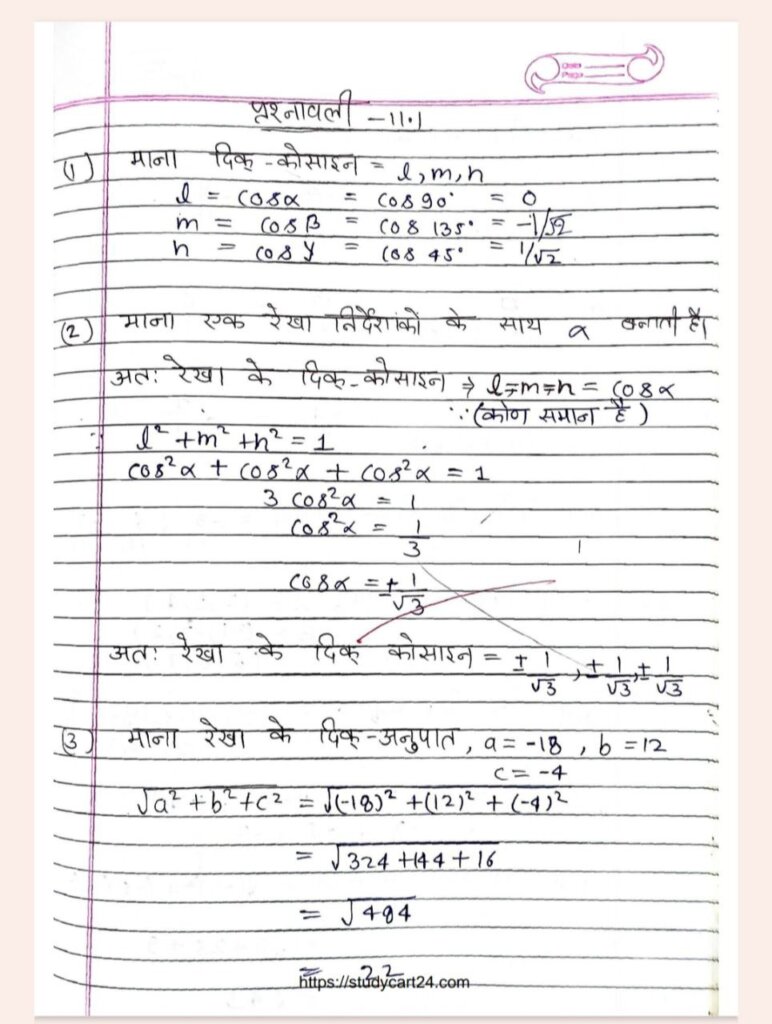
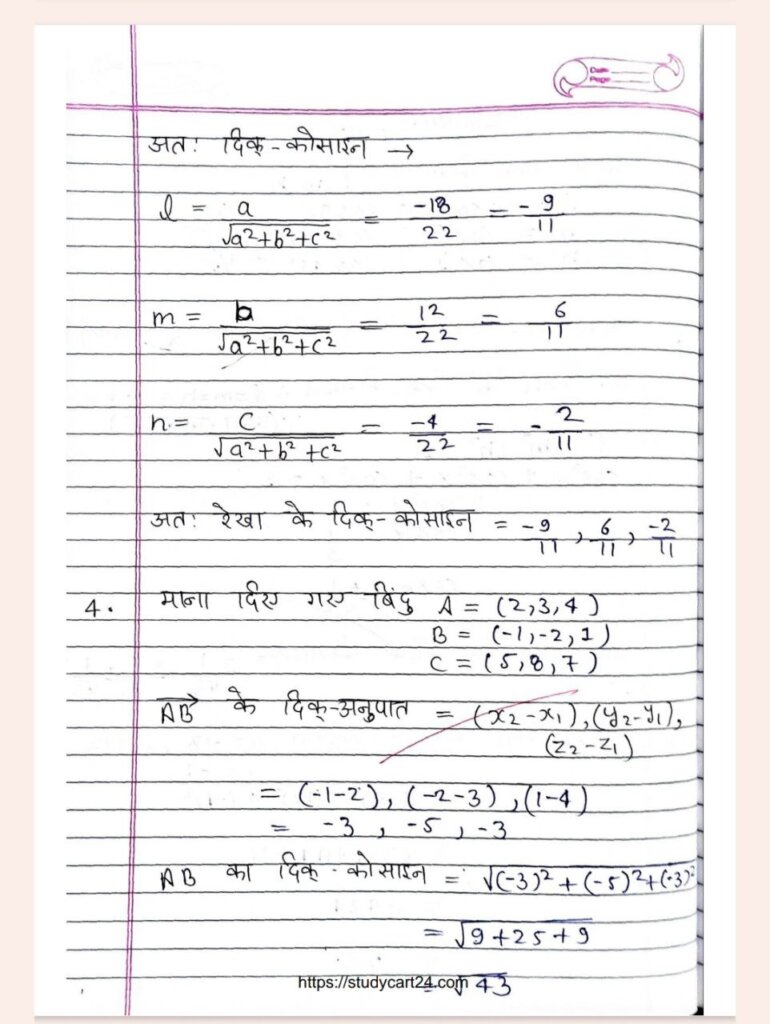
Related Free Notes from Studycart24.com of Class 12
- Class 12 Biology Handwritten Notes PDF Free Download- StudyCart24.com
- Class 12 Business Studies Notes: FREE Notes Chapter 1 to 12
- Complete Class 12 Chemistry Notes PDF with All Chapters for Free
- Class 12 Computer Science Notes PDF in English Free Download
- Class 12 Geography Notes: Download Free PDF of All Chapters in English
- Class 12 Physics Handwritten Notes in English PDF Download
🙏 Support Our Work
We work very hard to create quality handwritten notes to support your learning journey. Every page is the result of hours of dedication and care. If you find our efforts valuable, please consider supporting us. Even a small contribution of ₹5, ₹10, ₹50, or ₹100 — whatever feels right to you — can make a big difference. Your support helps us continue this platform and keep the notes accessible to everyone. Donate securely via PhonePe – your kindness truly means a lot.

UPI ID:
(Tap to copy)
Please Donate ₹5, ₹10, ₹50, ₹100 or whatever feels right to you.
Suggested Notes Links from Amazon Related to Class 12 Math’s Handwritten Notes
Oswaal CBSE Question Bank Chapterwise and Topicwise SOLVED PAPERS Class 12 Mathematics For Exam 2026
PW CBSE Question & Concept Bank (QCB) Class 12 Mathematics Chapter-wise and Topic-wise Solved Questions For 2026 Exams with 50% Competency Based Question
MTG CBSE Class-12 100 Percent Mathematics For 2025-26 Board Exam | As Per Latest NCERT & CBSE Syllabus | Chapter-Wise Question Bank, Theory, Diagrams Available All in One Book
Key Features of Three Dimensional Geometry Class 12 NCERT Solutions | Free Handwritten Notes Download in Hindi
- Subject: Maths (Class 12 Math’s Chapter 11 Three Dimensional Geometry )
- Language : Hindi
- Total pages : 32
- File size: 15.5 MB
- Format : PDF
- Well structured and easy to understand
- Includes importance formulas and definitions
- Covers all NCERT syllabus topics
- Useful for quick revision before exam
Definition – Chapter 11: Three-Dimensional Geometry (Class 12 Math’s)
Three-Dimensional Geometry is the branch of geometry that deals with the study of points, lines, planes, and their relationships in a three-dimensional (3D) space. Unlike two-dimensional geometry, which involves only the x and y coordinates, three-dimensional geometry introduces a third coordinate, z, to represent the position of a point in space.
In simple terms, any point in 3D space is represented as (x, y, z), where:
- x → Position along the X-axis
- y → Position along the Y-axis
- z → Position along the Z-axis
This chapter focuses on understanding:
- Direction cosines and direction ratios of a line.
- Equations of lines and planes in vector and Cartesian forms.
- Angles between lines, planes, and between a line and a plane.
- Shortest distance between two skew lines.
Thus, Three-Dimensional Geometry helps in visualizing and solving problems related to objects and their positions in space, which is highly useful in fields like physics, engineering, and architecture.
Key Topics – Chapter 11: Three-Dimensional Geometry (Class 12 Maths)
- Introduction to 3D Geometry
- Basics of 3D coordinate system
- Representation of a point in space (x,y,z)(x, y, z)(x,y,z)
- Direction Cosines & Direction Ratios
- Definition of direction cosines (l, m, n)
- Properties of direction cosines
- Relationship between direction cosines and direction ratios
- Equation of a Line
- Vector form of a line
- Cartesian form of a line
- Symmetrical form of a line
- Conditions for two lines to be parallel or intersecting
- Angle Between Two Lines
- Formula for angle between two lines using direction cosines
- Shortest Distance Between Two Skew Lines
- Formula for shortest distance
- Vector & Cartesian approach
- Equation of a Plane
- Vector form of a plane
- Cartesian form of a plane
- Normal form of a plane
- Angle Between Two Planes
- Formula for angle between two planes
- Angle Between a Line and a Plane
- Derivation and formula
- Distance of a Point from a Plane
- Perpendicular distance formula
- Miscellaneous Problems
- Application-based and conceptual questions
10 Important Definitions from Chapter 11: Three-Dimensional Geometry (Class 12 Maths Solutions PDF)
1. Three-Dimensional Geometry
It is the branch of geometry that studies the position of points, lines, and planes in space using three coordinates (x,y,z)(x, y, z)(x,y,z).
2. Coordinates of a Point
In 3D space, the position of a point is represented by an ordered triplet (x,y,z)(x, y, z)(x,y,z), where x, y, z denote its distances from the three mutually perpendicular axes (X, Y, Z).
3. Direction Cosines (l, m, n)
The cosines of the angles made by a directed line with the positive directions of the X, Y, and Z axes are called its direction cosines.
4. Direction Ratios (a, b, c)
Any three numbers proportional to the direction cosines of a line are called its direction ratios.
5. Equation of a Line
A line in space can be expressed in vector form or Cartesian form, representing all points lying on that line.
6. Skew Lines
Two lines in 3D space are called skew lines if they are neither parallel nor intersecting.
7. Shortest Distance (S.D.) Between Two Lines
The minimum distance between two skew lines is called their shortest distance, measured along a line perpendicular to both.
8. Equation of a Plane
A plane can be represented in vector form or Cartesian form, usually written as Ax+By+Cz+D=0Ax + By + Cz + D = 0Ax+By+Cz+D=0, where A, B, C are direction ratios of its normal.
9. Normal to a Plane
A line perpendicular to a plane is called its normal, and its direction ratios (A, B, C) define the orientation of the plane.
10. Angle Between Line and Plane / Two Planes
The angle between a line and a plane or between two planes is calculated using their direction cosines and normal vectors.
Step-By-Step Preparation Strategy for Chapter 11: Three-Dimensional Geometry (Class 12 Math’s)
1. Understand the Basics First
- Revise coordinate geometry of 2D from Class 11 (lines, slopes, distance, etc.) as it forms the foundation.
- Clearly understand the 3D coordinate system and the concept of a point in space (x,y,z)(x, y, z)(x,y,z).
2. Focus on Key Formulas
- Memorize formulas for:
- Direction cosines & direction ratios
- Equation of line (vector & Cartesian forms)
- Equation of plane (normal, vector & Cartesian forms)
- Angles between lines/planes/line & plane
- Shortest distance between skew lines
- Distance of a point from a plane
- Create a formula sheet for daily quick revision.
3. Visualize the Concepts
- Draw diagrams for lines, planes, and angles to understand spatial relationships.
- Practice problems that involve interpretation of 3D figures.
4. Solve NCERT Exercises Thoroughly
- Start with examples (they explain step-by-step solutions).
- Then solve all exercise questions (they are frequently asked in board exams).
- Don’t skip miscellaneous exercises – they help in advanced problem-solving.
5. Practice Previous Years’ Questions
- Go through last 5–10 years’ CBSE board papers for this chapter.
- Identify repeated question types (like angles, shortest distance, etc.).
6. Clear Common Doubts
- Understand the difference between skew lines & intersecting lines.
- Learn to convert between vector form ↔ Cartesian form quickly.
7. Time-bound Practice
- Solve mixed problems in a timed manner (as in exams).
- Focus on step-wise presentation since marks are given for each step in board exams.
8. Revise Regularly
- Spend 10–15 minutes daily revising formulas & concepts.
- Use flashcards or a handwritten cheat sheet for quick recall.
Would you like me to make a one-page handwritten-style cheat sheet for:
- All key formulas
- Important definitions
- Diagrams for easy visualization
Chapter-Wise Breakdown of Subtopics for Chapter 11: Three-Dimensional Geometry (Class 12 Maths):
Chapter 11: Three-Dimensional Geometry – Subtopics
- Introduction to 3D Geometry
- Basics of 3D coordinate system
- Representation of a point in 3D space (x,y,z)(x, y, z)(x,y,z)
- Direction Cosines and Direction Ratios
- Definition of direction cosines (l, m, n)
- Properties of direction cosines
- Relationship between direction cosines and direction ratios
- Equation of a Line
- Vector form of a line
- Cartesian form of a line
- Symmetrical form of a line
- Conditions for lines to be parallel, intersecting, or skew
- Angle Between Two Lines
- Formula for angle between two lines using direction cosines
- Shortest Distance Between Two Lines
- Skew lines and their shortest distance
- Formula for shortest distance (vector & Cartesian forms)
- Equation of a Plane
- Vector form of a plane
- Cartesian form of a plane
- Normal form of a plane
- Angle Between Two Planes
- Derivation and formula for angle between planes
- Angle Between a Line and a Plane
- Derivation and formula
- Distance of a Point from a Plane
- Perpendicular distance formula
- Miscellaneous Problems
- Application-based and conceptual questions
Why 3D Geometry Class 12 NCERT Solutions PDF Notes Are Special for You?
These handwritten notes for Chapter 11: Three-Dimensional Geometry (Class 12 Maths) are specially designed to make your preparation simple, effective, and exam-oriented. Here’s why they stand out:
- Easy-to-Understand Language – The notes are written in clear and simple words, making even complex concepts easy to grasp.
- Well-Organized Structure – All formulas, definitions, and theorems are arranged topic-wise, so you can quickly find what you need.
- Exam-Oriented Content – Focus on important questions, formulas, and shortcuts frequently asked in board exams.
- Visual Learning – Includes diagrams, flowcharts, and highlighted key points to help you visualize 3D concepts easily.
- Quick Revision Friendly – Designed for last-minute revision, so you can go through the entire chapter in 10–15 minutes.
- Covers NCERT + Extra Questions – Along with NCERT exercises, additional practice problems are included for better conceptual clarity.
- Handwritten Feel – Gives a classroom notebook experience, making learning natural and engaging.
In short, these notes are your all-in-one solution for mastering Three-Dimensional Geometry — from learning concepts to acing exams.
Top 15 Benefits of Using Handwritten Notes for Chapter 11: Three-Dimensional Geometry (Class 12 Maths)
1. Easy to Understand
Concepts are explained in simple, student-friendly language.
2. Well-Organized Content
All formulas, definitions, and examples are neatly arranged topic-wise.
3. Exam-Oriented Approach
Focus on important formulas & problem types frequently asked in board exams.
4. Quick Revision
Helps you revise the entire chapter in 10–15 minutes before exams.
5. Better Memory Retention
Handwritten content improves visual and muscle memory, making it easier to recall.
6. Visual Representation
Includes diagrams, flowcharts, and highlights to understand spatial concepts clearly.
7. Saves Time
No need to prepare separate notes — everything is ready-made and concise.
8. Covers NCERT + Extra
Includes all NCERT solutions along with extra important questions for practice.
9. Step-by-Step Solutions
Provides detailed stepwise solutions to make problem-solving easy.
10. Easy to Carry Anywhere
Compact and handy — perfect for on-the-go revision.
11. Reduces Stress
With everything well-organized, you can study without confusion or last-minute panic.
12. Strengthens Fundamentals
Builds a strong conceptual foundation for competitive exams (JEE, NDA, etc.).
13. Improves Presentation Skills
Teaches how to write neat and stepwise answers, just like examiners expect.
14. Saves Coaching Dependence
Makes self-study more effective, reducing the need for extra coaching help.
15. Boosts Confidence
With all key points in one place, you feel exam-ready and confident.
Important Topics – Chapter 11: Three-Dimensional Geometry Class 12 Math’s
| S.No. | Topic | Key Formula / Concept | Marks Weightage |
|---|---|---|---|
| 1 | Basics of 3D Coordinate System | Point in space: (x,y,z)(x, y, z)(x,y,z); Distance: (x2−x1)2+(y2−y1)2+(z2−z1)2\sqrt{(x_2-x_1)^2+(y_2-y_1)^2+(z_2-z_1)^2}(x2−x1)2+(y2−y1)2+(z2−z1)2 | 1–2 |
| 2 | Direction Cosines (D.C.) & Ratios (D.R.) | l=cosα,m=cosβ,n=cosγl = \cos\alpha, m = \cos\beta, n = \cos\gammal=cosα,m=cosβ,n=cosγ; l2+m2+n2=1l^2 + m^2 + n^2 = 1l2+m2+n2=1 | 2–3 |
| 3 | Equation of a Line | Vector: r⃗=a⃗+λb⃗\vec{r} = \vec{a} + \lambda \vec{b}r=a+λb; Cartesian: x−x1a=y−y1b=z−z1c\frac{x – x_1}{a} = \frac{y – y_1}{b} = \frac{z – z_1}{c}ax−x1=by−y1=cz−z1 | 3–4 |
| 4 | Angle Between Two Lines | cosθ=l1l2+m1m2+n1n2\cos\theta = l_1l_2 + m_1m_2 + n_1n_2cosθ=l1l2+m1m2+n1n2 | 2–3 |
| 5 | Shortest Distance Between Two Lines | S.D. = (\frac{ | (\vec{a_2}-\vec{a_1}) \cdot (\vec{b_1} \times \vec{b_2}) |
| 6 | Equation of a Plane | Vector: r⃗⋅n⃗=d\vec{r} \cdot \vec{n} = dr⋅n=d; Cartesian: Ax+By+Cz+D=0Ax + By + Cz + D = 0Ax+By+Cz+D=0 | 3–4 |
| 7 | Angle Between Two Planes | cosθ=A1A2+B1B2+C1C2A12+B12+C12A22+B22+C22\cos\theta = \frac{A_1A_2 + B_1B_2 + C_1C_2}{\sqrt{A_1^2+B_1^2+C_1^2} \sqrt{A_2^2+B_2^2+C_2^2}}cosθ=A12+B12+C12A22+B22+C22A1A2+B1B2+C1C2 | 2–3 |
| 8 | Angle Between a Line and a Plane | (\sin\theta = \frac{ | Aa+Bb+Cc |
| 9 | Distance of a Point from a Plane | (d = \frac{ | Ax_1 + By_1 + Cz_1 + D |
| 10 | Miscellaneous Problems | Combination of above concepts for application-based questions | 4–6 |
Complete list of Important Formulas for Chapter 11: Three-Dimensional Geometry (Class 12 Math’s)
1. Direction Cosines & Direction Ratios
- Direction Cosines: l=cosα, m=cosβ, n=cosγl = \cos\alpha,\ m = \cos\beta,\ n = \cos\gammal=cosα, m=cosβ, n=cosγ
- Condition: l2+m2+n2=1l^2 + m^2 + n^2 = 1l2+m2+n2=1
- Relation between D.C. & D.R.: If a,b,ca, b, ca,b,c are direction ratios, then l=aa2+b2+c2, m=ba2+b2+c2, n=ca2+b2+c2l = \frac{a}{\sqrt{a^2 + b^2 + c^2}},\ m = \frac{b}{\sqrt{a^2 + b^2 + c^2}},\ n = \frac{c}{\sqrt{a^2 + b^2 + c^2}}l=a2+b2+c2a, m=a2+b2+c2b, n=a2+b2+c2c
2. Equation of a Line
- Vector Form: r⃗=a⃗+λb⃗\vec{r} = \vec{a} + \lambda \vec{b}r=a+λb where a⃗\vec{a}a is a position vector, b⃗\vec{b}b is the direction vector.
- Cartesian Form: x−x1a=y−y1b=z−z1c\frac{x – x_1}{a} = \frac{y – y_1}{b} = \frac{z – z_1}{c}ax−x1=by−y1=cz−z1
3. Angle Between Two Lines
cosθ=a1a2+b1b2+c1c2a12+b12+c12⋅a22+b22+c22\cos\theta = \frac{a_1a_2 + b_1b_2 + c_1c_2}{\sqrt{a_1^2 + b_1^2 + c_1^2} \cdot \sqrt{a_2^2 + b_2^2 + c_2^2}}cosθ=a12+b12+c12⋅a22+b22+c22a1a2+b1b2+c1c2
4. Shortest Distance Between Two Lines
If two lines are: r⃗=a1⃗+λb1⃗andr⃗=a2⃗+μb2⃗\vec{r} = \vec{a_1} + \lambda \vec{b_1} \quad \text{and} \quad \vec{r} = \vec{a_2} + \mu \vec{b_2}r=a1+λb1andr=a2+μb2
then S.D.=∣(a2⃗−a1⃗)⋅(b1⃗×b2⃗)∣∣b1⃗×b2⃗∣\mathrm{S.D.} = \frac{|(\vec{a_2} – \vec{a_1}) \cdot (\vec{b_1} \times \vec{b_2})|}{|\vec{b_1} \times \vec{b_2}|}S.D.=∣b1×b2∣∣(a2−a1)⋅(b1×b2)∣
5. Equation of a Plane
- Vector Form: r⃗⋅n⃗=d\vec{r} \cdot \vec{n} = dr⋅n=d
- Cartesian Form: Ax+By+Cz+D=0Ax + By + Cz + D = 0Ax+By+Cz+D=0
- Normal Form: lx+my+nz=plx + my + nz = plx+my+nz=p where l,m,nl, m, nl,m,n are direction cosines of the normal.
6. Angle Between Two Planes
cosθ=A1A2+B1B2+C1C2A12+B12+C12⋅A22+B22+C22\cos\theta = \frac{A_1A_2 + B_1B_2 + C_1C_2}{\sqrt{A_1^2 + B_1^2 + C_1^2} \cdot \sqrt{A_2^2 + B_2^2 + C_2^2}}cosθ=A12+B12+C12⋅A22+B22+C22A1A2+B1B2+C1C2
7. Angle Between a Line and a Plane
sinθ=∣Aa+Bb+Cc∣A2+B2+C2⋅a2+b2+c2\sin\theta = \frac{|Aa + Bb + Cc|}{\sqrt{A^2 + B^2 + C^2} \cdot \sqrt{a^2 + b^2 + c^2}}sinθ=A2+B2+C2⋅a2+b2+c2∣Aa+Bb+Cc∣
8. Distance of a Point from a Plane
For a point (x1,y1,z1)(x_1, y_1, z_1)(x1,y1,z1) and plane Ax+By+Cz+D=0Ax + By + Cz + D = 0Ax+By+Cz+D=0: d=∣Ax1+By1+Cz1+D∣A2+B2+C2d = \frac{|Ax_1 + By_1 + Cz_1 + D|}{\sqrt{A^2 + B^2 + C^2}}d=A2+B2+C2∣Ax1+By1+Cz1+D∣
FAQs (Frequently Asked Questions) for Chapter 11: Three-Dimensional Geometry (Class 12 Math’s)
It focuses on understanding the position and relationships of points, lines, and planes in three-dimensional space.
It helps in solving real-world problems in fields like physics, engineering, architecture, and computer graphics and is also crucial for competitive exams.
Direction Cosines: Cosines of the angles a line makes with the X, Y, and Z axes.
Direction Ratios: Any set of numbers proportional to the direction cosines.
Two lines in space that do not intersect and are not parallel are called skew lines.
It represents all points lying on a straight line in three-dimensional space.
It represents a flat surface in three-dimensional space that extends infinitely in two directions.
The normal is a line perpendicular to the plane, and its direction defines the orientation of the plane.
Typically, questions involve finding equations of lines/planes, angles between them, and conceptual understanding of spatial relationships.
Focus on understanding formulas, practicing NCERT examples, and solving previous years’ board questions.
Yes, this chapter is very important for JEE, NDA, and other entrance exams as it builds strong fundamentals for higher-level geometry and vector problems.
Class 12 Math’s – Preparation Strategy (Quick Table)
| Step | Strategy | Why It’s Important |
|---|---|---|
| 1 | Master NCERT First | NCERT is the base; most board questions are from here. |
| 2 | Make a Formula Sheet | Quick reference saves revision time before exams. |
| 3 | Set Daily Study Targets | Helps cover the syllabus systematically without stress. |
| 4 | Solve Previous Years’ Papers | Familiarizes you with exam patterns & frequently asked questions. |
| 5 | Focus on High-Weightage Chapters | Maximizes scoring potential (Calculus, 3D Geometry, Vectors, Probability). |
| 6 | Learn Step-Wise Presentation | Boards give marks for steps even if the final answer is wrong. |
| 7 | Practice Miscellaneous & HOTS | Builds conceptual clarity and improves problem-solving skills. |
| 8 | Use Diagrams & Graphs | Makes solutions easy to understand & fetches better marks. |
| 9 | Revise Daily (15–20 mins) | Keeps formulas & concepts fresh in memory. |
| 10 | Attempt Mock Tests Under Exam Conditions | Improves time management & builds confidence. |
Common Mistakes – Chapter 11: Three-Dimensional Geometry Class 12 Math’s
| S.No. | Mistake | How to Avoid It |
|---|---|---|
| 1 | Confusing Direction Cosines (D.C.) with Direction Ratios (D.R.) | Remember: D.C. are cosines of angles with axes (always satisfy l2+m2+n2=1l^2 + m^2 + n^2 = 1l2+m2+n2=1); D.R. are just proportional values. |
| 2 | Forgetting to Normalize Direction Ratios | Always convert D.R. to D.C. using: l=aa2+b2+c2l = \frac{a}{\sqrt{a^2+b^2+c^2}}l=a2+b2+c2a. |
| 3 | Using Wrong Sign in Distance Formula | Always use absolute value: (d = \frac{ |
| 4 | Mixing up Vector & Cartesian Forms | Clearly identify which form is needed; rewrite vectors as components before solving. |
| 5 | Misinterpreting Skew Lines as Intersecting | Check if lines intersect by solving equations; if no solution & not parallel → skew lines. |
| 6 | Errors in Shortest Distance Formula | Carefully apply cross product & dot product; memorize the vector S.D. formula. |
| 7 | Forgetting to Draw Diagrams | Always sketch the position of lines/planes to visualize the problem. |
| 8 | Not Checking for Parallel or Perpendicular Conditions | Use dot product (=0=0=0 for perpendicular) or ratios for parallelism before solving. |
| 9 | Skipping Step-Wise Solutions | Boards give marks for steps — write each step clearly instead of jumping to the answer. |
| 10 | Neglecting Miscellaneous Questions | These are often tricky but frequently asked in exams — practice them well. |
Summary Table – Chapter 11: Three-Dimensional Geometry Class 12 Math’s
| Concept | Key Points / Formula |
|---|---|
| Point in 3D | A point in space is represented as (x,y,z)(x, y, z)(x,y,z). |
| Direction Cosines (D.C.) | l=cosα, m=cosβ, n=cosγl = \cos\alpha,\ m = \cos\beta,\ n = \cos\gammal=cosα, m=cosβ, n=cosγ; l2+m2+n2=1l^2 + m^2 + n^2 = 1l2+m2+n2=1. |
| Direction Ratios (D.R.) | Any three numbers proportional to D.C. of a line; Convert to D.C. using: l=aa2+b2+c2l = \frac{a}{\sqrt{a^2 + b^2 + c^2}}l=a2+b2+c2a. |
| Equation of a Line | Vector form: r⃗=a⃗+λb⃗\vec{r} = \vec{a} + \lambda \vec{b}r=a+λb Cartesian form: x−x1a=y−y1b=z−z1c\frac{x – x_1}{a} = \frac{y – y_1}{b} = \frac{z – z_1}{c}ax−x1=by−y1=cz−z1. |
| Angle Between Two Lines | cosθ=a1a2+b1b2+c1c2a12+b12+c12⋅a22+b22+c22\cos\theta = \frac{a_1a_2 + b_1b_2 + c_1c_2}{\sqrt{a_1^2 + b_1^2 + c_1^2} \cdot \sqrt{a_2^2 + b_2^2 + c_2^2}}cosθ=a12+b12+c12⋅a22+b22+c22a1a2+b1b2+c1c2. |
| Shortest Distance Between Two Skew Lines | (\mathrm{S.D.} = \frac{ |
| Equation of a Plane | Vector form: r⃗⋅n⃗=d\vec{r} \cdot \vec{n} = dr⋅n=d. Cartesian form: Ax+By+Cz+D=0Ax + By + Cz + D = 0Ax+By+Cz+D=0. Normal form: lx+my+nz=plx + my + nz = plx+my+nz=p. |
| Angle Between Two Planes | cosθ=A1A2+B1B2+C1C2A12+B12+C12⋅A22+B22+C22\cos\theta = \frac{A_1A_2 + B_1B_2 + C_1C_2}{\sqrt{A_1^2 + B_1^2 + C_1^2} \cdot \sqrt{A_2^2 + B_2^2 + C_2^2}}cosθ=A12+B12+C12⋅A22+B22+C22A1A2+B1B2+C1C2. |
| Angle Between a Line and a Plane | (\sin\theta = \frac{ |
| Distance of a Point from a Plane | (d = \frac{ |
Conclusion – Chapter 11: Three-Dimensional Geometry (Class 12 Math’s)
Chapter 11, Three-Dimensional Geometry, plays a crucial role in Class 12 Mathematics as it extends the concepts of coordinate geometry into three-dimensional space. This chapter equips students with the ability to represent and analyze the positions of points, lines, and planes using vector and Cartesian forms. By learning about direction cosines, direction ratios, equations of lines and planes, angles between them, and the shortest distance between skew lines, students gain essential tools to solve spatial problems effectively. These concepts are not only important for board examinations but also form the foundation for competitive exams like JEE, NDA, and other entrance tests, where visualization and application of 3D space are frequently tested.
Mastering this chapter requires a clear understanding of formulas, step-by-step problem-solving techniques, and geometric visualization. Students should practice NCERT exercises, miscellaneous questions, and previous years’ papers to build confidence. With consistent revision and a structured approach, Three-Dimensional Geometry becomes a scoring chapter. Ultimately, this topic bridges the gap between theoretical mathematics and real-life applications in fields such as engineering, physics, and architecture, making it an indispensable part of advanced mathematics learning.
Tags:-
 Chapter 11: Three-Dimensional Geometry (Class 12 Maths):
Three Dimensional Geometry Class 12
Three Dimensional Geometry Class 12 Maths Notes
NCERT Solutions for Class 12 Maths Chapter 11
Class 12 Maths Chapter 11 Handwritten Notes
Three Dimensional Geometry Class 12 Formulas
3D Geometry Class 12 Notes
Three Dimensional Geometry Important Questions
CBSE Class 12 Maths Chapter 11 Solutions
Three Dimensional Geometry Class 12 Summary
Three Dimensional Geometry Class 12 Revision Notes
Class 12 Maths Chapter 11 PDF Download
Three Dimensional Geometry Class 12 NCERT Solutions
3D Geometry Class 12 Important Formulas
Three Dimensional Geometry Class 12 Preparation Tips
Three Dimensional Geometry Class 12 Short Notes
Chapter 11: 3D Geometry Class 12 NCERT Solutions PDF,
Class 12 Maths Handwritten Notes Download,

