
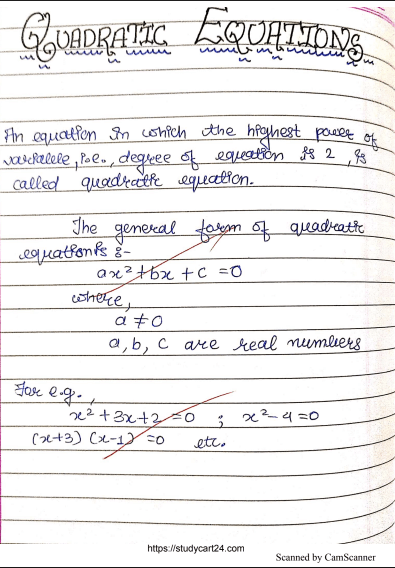
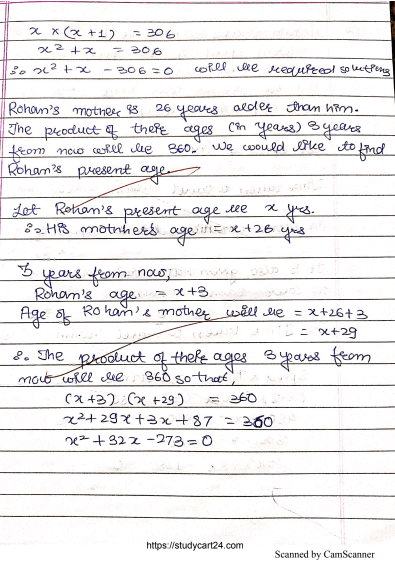
Quadratic Equations Class 10 PDF: Chapter 4 forms a critical part of the Class 10 Maths syllabus. We provide you, Free of Cost, easily downloadable Handwritten Notes in a PDF format for offline study, and a well-organized approach to mastering Quadratic Equations concepts. These detailed notes in English are presented in a streamlined format across 17 pages; a compact size of just 3.5 MB. In this article, you will find detailed insights about Chapter 4: Quadratic Equations. Furthermore, we explore the features of these notes, provide a preview, share important topics, previously asked questions, one-liners with answers, FAQs, and useful tables to help you excel in your exam preparation.
 Join Telegram
 Join WhatsApp
Features of Chapter 4: Quadratic Equations Class 10 PDF
| Subject : | Mathematics |
| Class: | 10th |
| Chapter: 4 | Quadratic Equations |
| Size: | 3.5 MB |
| Pages: | 17 |
| Language: | English |
| Format: | PDF (click the download button in the section below |
- Concise and Comprehensive: Each concept—standard form, discriminant, roots, nature of roots, and more—is explained succinctly yet thoroughly.
- Student‑Friendly Handwriting: Clean, legible, and easy to follow, ideal for both classroom revision and home study.
- Structured Layout: Numbered headings, properly aligned symbols and equations, and clearly boxed formulas for quick reference.
- Visual Aids: Step-by-step derivations, flowcharts, and annotated tips that help improve retention.
- Exam Tip Box: Handy reminders about typical tricks, pitfalls, and frequently tested concepts.
2. Preview and Download Link of the Notes
Images of Chapter 4: Quadratic Equations Class 10

| Related Notes | URL |
|---|---|
| Class 10 Social Science Notes PDF – Chapterwise Handwritten Notes (Free Download) | view here |
| Chapter 20 Economics – Sectors of the Indian Economy Class 10 Notes PDF Download | view here |
| Chapter 22: Economics – Globalization and the Indian Economy Class 10 Notes | view here |
Other Recommended Study Materials from AMAZON
| Amazon Product description | Checkout links |
|---|---|
| All In One Mathematics – 10th | click here |
| Oswaal CBSE & NCERT One for All Class 10 Science (For 2026 Exam) | click here |
🙏 Support Our Work
We work very hard to create quality handwritten notes to support your learning journey. Every page is the result of hours of dedication and care. If you find our efforts valuable, please consider supporting us. Even a small contribution of ₹5, ₹10, ₹50, or ₹100 — whatever feels right to you — can make a big difference. Your support helps us continue this platform and keep the notes accessible to everyone. Donate securely via PhonePe – your kindness truly means a lot.

UPI ID:
(Tap to copy)
Please Donate ₹5, ₹10, ₹50, ₹100 or whatever feels right to you.
3. How to Prepare for Chapter 4: Quadratic Equations Class 10
Understand the Basics First
Before diving into solving, ensure you have mastered:
- Standard Form: Recognize and correctly write ax² + bx + c = 0
- Coefficient Roles: Know how each parameter (a, b, c) affects the parabola’s shape, position, and roots
Learn All Solution Methods
- Factorization
- Best for easy quadratics
- Requires spotting factorable patterns: x² + 5x + 6 = (x + 2)(x + 3) = 0 → x = –2, –3
- Completing the Square
- Useful when factorization isn’t obvious
- Practice steps: divide by a, half b, square, rearrange
- Quadratic Formula
- Always applicable
- Memorize: x=−b±b2−4ac2ax = \frac{-b \pm \sqrt{b^2 – 4ac}}{2a}
- Relate discriminant to root nature:
- D > 0 → Two real & distinct
- D = 0 → One real (repeated)
- D < 0 → Two imaginary
Analyse the Discriminant
Knowing the discriminant helps predict root type without solving. Practice a range of values:
- Example: x² – 4x + 3 → D = 16 –12 = 4 → Two real roots
- Also explore negative D to reinforce concept of complex roots
Relate Roots and Coefficients
Remember and apply key formulas:
- Sum of roots: α+β=−ba\alpha + \beta = -\frac{b}{a}
- Product of roots: αβ=ca\alpha \beta = \frac{c}{a}
These are critical for “find sum & product” and constructing equations from given roots.
Consistent Practice
- Solve all NCERT Exercise 4.1 and 4.2 questions — they cover 80–90% of typical board exam patterns.
- Additionally, include sample paper questions, previous years’ board questions, and moderate to advanced problems.
4. Important Formulas from Chapter 4: Quadratic Equations Class 10
| Concept | Formula | Notes |
|---|---|---|
| Standard Form | ax2+bx+c=0ax^2 + bx + c = 0 | a ≠ 0 |
| Quadratic Formula | x=−b±b2−4ac2ax = \frac{-b \pm \sqrt{b^2 – 4ac}}{2a} | Universal root-finding tool |
| Discriminant (D) | b2−4acb^2 – 4ac | Determines root nature |
| Nature of Roots | D > 0, D = 0, D < 0 | Real & Distinct / Equal / Imaginary |
| Sum of Roots (α+β\alpha + \beta) | −ba-\frac{b}{a} | Useful in root-coefficient problems |
| Product of Roots (αβ\alpha \beta) | ca\frac{c}{a} | Useful in root-sum-product questions |
5. Previously Asked Questions from Chapter 4: Quadratic Equations Class 10
Exam boards typically test the following themes:
- Finding Roots: Use formula or factorization
- Example: Prove that mc² – 2mcn + n² = 0 yields roots nc\frac{n}{c} and nm\frac{n}{m}
- Nature of Roots: Classify based on discriminant
- e.g., For ax² + bx + c = 0, find values of k so roots are real or equal
- Relationship between Roots and Coefficients
- e.g., If sum of roots is double their product, find a/b + b/a
- Parametric Equations
- e.g., If α, β are roots of x² – (k+1)x + k = 0, find values of k for integer roots
- Word Problems requiring quadratic modeling
- e.g., A rectangular garden with area 48 m² — length = (width + 4); find dimensions
6. Questions That May Come in Exams
Based on recent trends, examiners often target:
- Direct Root Calculations: Using formula or completing the square
- Discriminant-Based Situations
- Determine for what k, x² – 4x + k = 0 has real roots
- Sum/Product-Based Derivations
- Often used in algebraic reasoning problems
- Formulating Equations from Given Root Conditions
- Highest probability of merit marks
Stay alert for twist questions: “roots differ by 4” or “sum is double product”.
7. One-Liners with Answers from Chapter 4: Quadratic Equations
To aid last-minute revision, here are crisp points:
- D = 0 → Roots are real & equal
- If roots are integer → b² must be a perfect square
- α + β = –b/a
- αβ = c/a
- Vertex formula: x = –b/2a
- Axis of symmetry: x = –b/2a
- Max/Min value of quadratic (for a > 0 → min; for a < 0 → max) is at x = –b/2a
- Axis of symmetry always bisects roots
- If roots are imaginary → b² < 4ac
8. Frequently Asked Questions (FAQs)
A. Three: Factorization, Completing the Square, Quadratic Formula. Each has its distinct uses.
A. Because it works for all quadratic equations, even when other methods fail.
A. Discriminant tells us whether roots are real and distinct (D>0), repeated (D=0), or imaginary (D<0).
A. Yes—if you know α + β = S and αβ = P, the equation is x² – Sx + P = 0.
A. Yes: memorizing formulae, focusing on discriminant logic, and avoiding heavy algebra when possible.
A. Find the provided PDF in the download and preview section, click on the download button to get the free PDF.
9. Summary Tables for Quick Revision
| Topic | Key Points |
|---|---|
| Forms of Solving | Factorization, Completing the Square, Formula |
| Vertex & Axis | Vertex at x = –b/2a; axis of symmetry same |
| Root Nature | D > 0 real; D = 0 equal; D < 0 imaginary |
| Root Relations | α + β = –b/a; αβ = c/a |
| Max/Min Value | f(–b/2a) gives extremum |
| Practical Value | Quadratics model projectile, area, finance, etc. |
Conclusion
To prepare effectively for Chapter 4: Quadratic Equations, start with a solid foundation: understand forms, methods, and formulae. Use our free downloadable handwritten notes for structured, offline revision. Practice with NCERT exercises and additional questions to gain confidence. Utilize quick-reference tables and one-liners for memorization. Finally, simulate exam conditions, focus on understanding, and you’ll unlock high-scoring potential in Class 10 Maths!
Tags: CBSE Board Exam Notes,
Class 10th Maths Exam Notes,
Diagrams Illustration And Formulas,
PYQs Class 10 Maths,
Class 10th CBSE Maths Notes,
Toppers Notes,
Free Notes In English,
Chapter 4 Quadratic Equations Formulas Class 10,
CBSE Class 10 Quadratic Equations Notes,
Quadratic Equations Formulas Class 10,
Important Formulas Class 10 Maths,
CBSE Maths Chapter wise Notes,
Maths Diagrams And Illustrations,
Class 10 Maths Study Material,
Quadratic Equations PYQs,
Free CBSE Notes Download,
Maths Notes For CBSE Class 10,
CBSE Class 10 Revision Notes,
Quadratic Equations Toppers Notes,
Handwritten Maths Formulas Notes
Quadratic Equations Class 10 PDF,

