How to Prepare for Competitive Exams with Job: Balancing a full-time job and preparing for competitive exams can be challenging, but it is entirely possible with a structured plan and disciplined approach. This article provides comprehensive strategies, detailed plans, and actionable tips to help working professionals effectively prepare for competitive exams without compromising their job responsibilities.
 Join Telegram
 Join WhatsApp
Overview of “How to Prepare for Competitive Exams with Job”
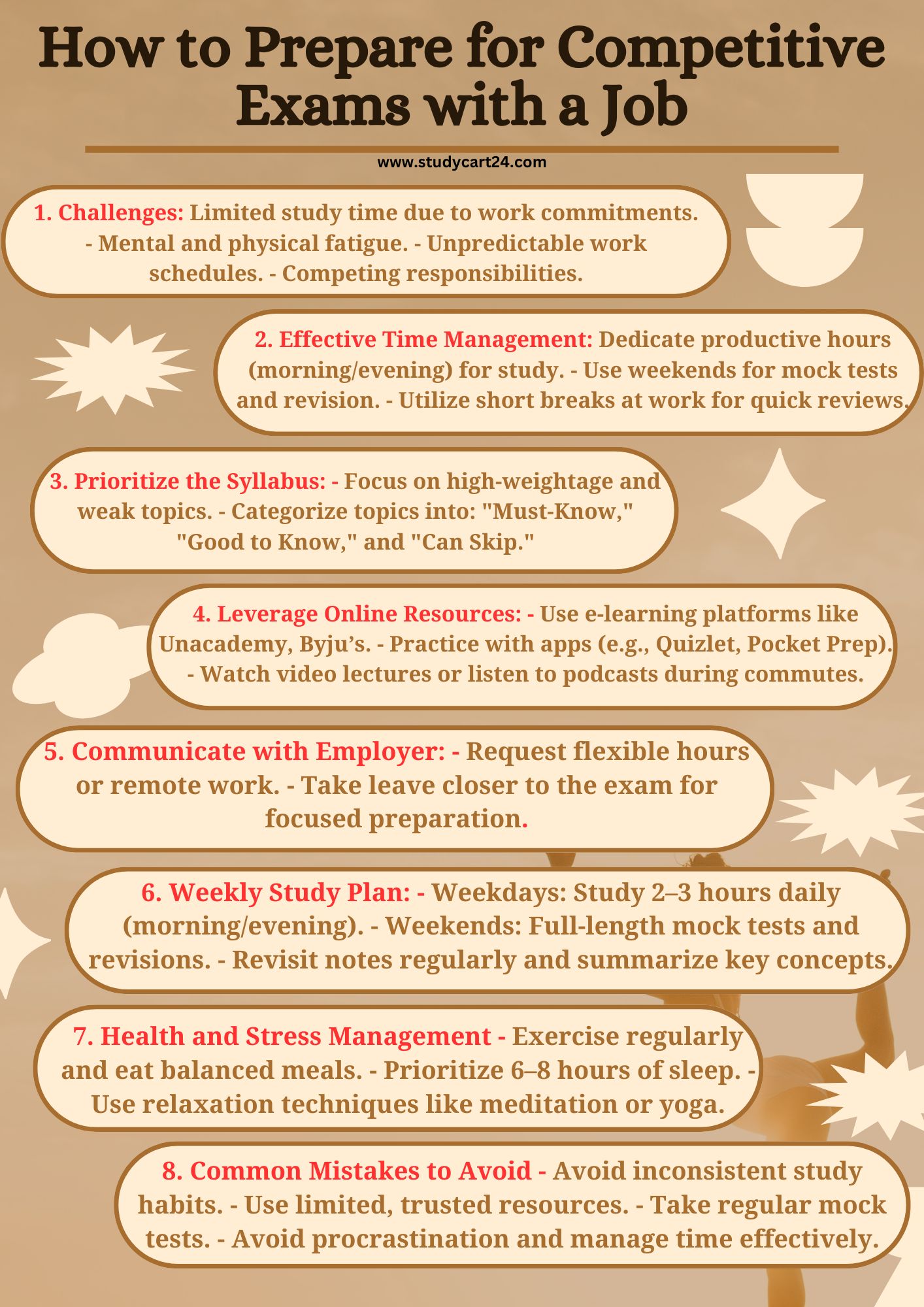

Preparing for Competitive Exams with Job is not a simple task to because there are so many challenges, responsibilities and other difficulties which make study bit harder as compared to other normal student. But there are so many peoples who qualified Competitive Exams with job.
You can prepare and qualify Competitive Exams by adopting right actionable strategies, effective timetable which will not hamper your job, Study Plan that works. Don’t forget to avoid to know and Common Mistakes made by most of the students who are Preparing for Competitive Exams with Job.
To Prepare for Competitive Exams with Job, you need to do smart study rather than hard work due to time limitation. You need to manage your valuable time, Mental and Physical Health, Unpredictable Work Schedule, Competing Priorities, Prioritize the Syllabus and proper Use of Work Breaks and holidays.
By following these strategies, professionals can balance work and competitive exam preparation effectively.
Challenges Faced by Working Professionals

1. Limited Time
Working professionals often struggle with limited hours for study due to job responsibilities and commuting time. This limitation requires a high level of efficiency and prioritization to make the most of available time.
2. Mental and Physical Fatigue
Juggling work and exam preparation can lead to exhaustion. Mental fatigue reduces focus, while physical tiredness may decrease productivity and motivation.
3. Unpredictable Work Schedule
Unplanned meetings, overtime, or urgent tasks at work can disrupt carefully planned study schedules, making consistency a significant challenge.
4. Competing Priorities
Family responsibilities, social commitments, and personal obligations further divide available time, leaving even less for focused study.
Related Post: What is Exam Stress? Symptoms, Causes, Effects & Management
🙏 Support Our Work
We work very hard to create quality handwritten notes to support your learning journey. Every page is the result of hours of dedication and care. If you find our efforts valuable, please consider supporting us. Even a small contribution of ₹5, ₹10, ₹50, or ₹100 — whatever feels right to you — can make a big difference. Your support helps us continue this platform and keep the notes accessible to everyone. Donate securely via PhonePe – your kindness truly means a lot.

UPI ID:
(Tap to copy)
Please Donate ₹5, ₹10, ₹50, ₹100 or whatever feels right to you.
Effective Strategies to Prepare for Competitive Exams with Job
1. Time Management
Time is your most valuable resource when balancing work and studies. Managing it effectively can significantly impact your preparation.
Daily Scheduling:
- Divide your day into specific slots for work, study, and personal activities.
- Identify your most productive hours (morning or night) and reserve them for studying high-priority topics.
- Use tools like planners or time-management apps to stay on track.
Weekend Focus:
- Dedicate weekends to covering larger topics or taking full-length mock tests.
- Use weekends for activities that require undivided attention, such as solving complex problems or revisiting weak areas.
Micro Study Sessions:
- Utilize short breaks at work to review notes, solve practice questions, or revise flashcards.
- Keep study materials accessible (e.g., apps, PDFs, or notebooks) for quick learning during commutes or free time.
| Time Slot | Activity |
|---|---|
| 6:00 AM – 7:00 AM | Study Session: New Topics |
| 9:00 AM – 6:00 PM | Work |
| 6:30 PM – 7:00 PM | Quick Revision of Morning Studies |
| 8:00 PM – 10:00 PM | Study Session: Practice/Mock Tests |
| 10:00 PM – 10:30 PM | Relaxation or Light Reading |
2. Prioritize the Syllabus
The syllabus of competitive exams is often vast, and attempting to cover everything can lead to inefficiency. Prioritizing topics is essential.
Identify Key Areas:
- Review the syllabus and mark high-priority topics based on their weightage and frequency in previous exams.
- Focus on areas where you’re weak but that also offer significant scoring potential.
Categorize Topics:
- Divide topics into categories such as “Must-Know,” “Good to Know,” and “Can Skip.”
- Allocate more time to high-priority topics while revisiting easier or familiar ones occasionally.
| Subject | Priority Level |
|---|---|
| Quantitative Aptitude | High |
| Logical Reasoning | Medium |
| General Awareness | High |
| English Language | Low |
3. Leverage Online Resources
The internet offers a wealth of resources that cater to working professionals. Leveraging these can save time and enhance preparation.
Benefits of Online Tools:
- Flexible learning schedules that fit around your job.
- Access to video lectures, crash courses, and practice tests on the go.
- Interactive tools for analyzing performance in mock tests.
Recommended Resources:
- E-Learning Platforms: Subscribe to platforms like Unacademy, Byju’s, or Khan Academy for structured learning.
- Mobile Apps: Use apps like Pocket Prep or Quizlet for quick practice during commutes.
- Videos and Podcasts: Listen to educational content during breaks or while traveling.
| Resource Type | Examples |
|---|---|
| Online Courses | Unacademy, Byju’s |
| Mock Test Platforms | Testbook, Oliveboard |
| Apps | Pocket Prep, Quizlet |
4. Utilize Weekends and Holidays
Weekends and public holidays are golden opportunities for working professionals to catch up on studies.
Weekend Plan:
- Dedicate mornings to learning new topics when your mind is fresh.
- Spend afternoons solving mock tests and analyzing mistakes to improve performance.
- Reserve evenings for revision and light reading to consolidate your learning.
Holiday Preparation:
- Use long weekends to tackle challenging subjects or revise an entire section.
- Schedule back-to-back practice tests to build exam stamina.
| Sample Weekend Schedule |
|---|
| 8:00 AM – 10:00 AM: Study New Topics |
| 11:00 AM – 1:00 PM: Practice Questions |
| 2:00 PM – 4:00 PM: Full-Length Mock Test |
| 5:00 PM – 6:30 PM: Review Mistakes |
| 7:30 PM – 8:30 PM: Revise Notes |
5. Make Use of Work Breaks
Short breaks during work hours can be surprisingly productive if utilized well.
Tips for Work Breaks:
- Carry a pocketbook or flashcards for quick revision.
- Use study apps to solve 2-3 practice questions during coffee breaks.
- Listen to podcasts or educational videos while commuting.
6. Communicate with Your Employer
If possible, inform your employer about your preparation. Transparent communication can lead to a more supportive work environment.
Suggestions:
- Request flexible working hours or remote work opportunities.
- Use paid leave or unpaid leave for focused preparation closer to the exam date.
- Avoid overburdening yourself with additional responsibilities during this period.
7. Stay Consistent with Revision
Regular revision is crucial to retain what you’ve learned. Without consistent review, knowledge can quickly fade.
Effective Revision Tips:
- Allocate time daily to revisit previously studied topics.
- Create summary notes, flowcharts, and mind maps for quick reviews.
- Schedule weekly revisions to assess your overall progress.
8. Health and Stress Management
Physical and mental well-being play a pivotal role in exam preparation. Neglecting health can lead to burnout and reduced productivity.
Tips for Staying Healthy:
- Exercise Regularly: Incorporate 20-30 minutes of physical activity daily to boost energy and focus.
- Eat Balanced Meals: Avoid junk food and prioritize meals rich in nutrients to maintain energy levels.
- Get Adequate Sleep: Ensure 6-8 hours of quality sleep each night to enhance memory retention.
- Relaxation Techniques: Practice meditation, yoga, or deep breathing exercises to manage stress.
Relates Post: Government Exam Preparation Online Free – SSC, IBPS, Railway, PSC
Sample Study Plan for Working Professionals

Creating a realistic and achievable study plan is essential for balancing work and exam preparation. Below is a detailed weekly plan tailored for professionals:
| Day | Activity |
|---|---|
| Monday-Friday | Study 2 hours daily (1 hour in the morning, 1 hour at night) |
| Saturday Morning | Study High-Priority Topics |
| Saturday Afternoon | Take a Full-Length Mock Test |
| Saturday Evening | Analyze Mistakes from the Mock Test |
| Sunday Morning | Revise the Entire Week’s Topics |
| Sunday Afternoon | Practice Questions or Solve Previous Papers |
| Sunday Evening | Prepare Summary Notes for Quick Revision |
Common Mistakes to Avoid
1. Inconsistent Efforts
Irregular study habits can lead to gaps in knowledge and lower confidence. Consistency is key.
2. Overloading Resources
Using too many books or online platforms can cause confusion. Stick to a few trusted resources.
3. Neglecting Mock Tests
Mock tests are essential for assessing progress and improving speed and accuracy.
4. Ignoring Health
Skipping meals, losing sleep, or neglecting exercise can lead to burnout and reduced efficiency.
5. Procrastination
Delaying study sessions or revising can accumulate stress closer to the exam date.
Summary List of Important Steps
| Key Areas | Details |
|---|---|
| 1. Challenges | – Limited study time due to work commitments. – Mental and physical fatigue. – Unpredictable work schedules. – Competing responsibilities. |
| 2. Effective Time Management | – Dedicate productive hours (morning/evening) for study. – Use weekends for mock tests and revision. – Utilize short breaks at work for quick reviews. |
| 3. Prioritize the Syllabus | – Focus on high-weightage and weak topics. – Categorize topics into: “Must-Know,” “Good to Know,” and “Can Skip.” |
| 4. Leverage Online Resources | – Use e-learning platforms like Unacademy, Byju’s. – Practice with apps (e.g., Quizlet, Pocket Prep). – Watch video lectures or listen to podcasts during commutes. |
| 5. Communicate with Employer | – Request flexible hours or remote work. – Take leave closer to the exam for focused preparation. |
| 6. Weekly Study Plan | – Weekdays: Study 2–3 hours daily (morning/evening). – Weekends: Full-length mock tests and revisions. – Revisit notes regularly and summarize key concepts. |
| 7. Health and Stress Management | – Exercise regularly and eat balanced meals. – Prioritize 6–8 hours of sleep. – Use relaxation techniques like meditation or yoga. |
| 8. Common Mistakes to Avoid | – Avoid inconsistent study habits. – Use limited, trusted resources. – Take regular mock tests. – Avoid procrastination and manage time effectively. |
Related Post: How Digital Education is Shaping the Future of Learning- StudyCart24
FAQs on How to Prepare for Competitive Exams with Job
1. Can I crack competitive exams while working full-time?
2. How many hours should I study daily?
3. Should I join coaching classes while working?
4. How do I handle work pressure during preparation?
5. What should I do if I fall behind in my study plan?
6. Can I crack competitive exams while working full-time?
2. How many hours should I study daily?
Weekdays: Spend 1 hour in the morning and another 1–2 hours at night.
Weekends: Utilize the extra time for mock tests, analyzing mistakes, and revising.
The quality of study matters more than the quantity, so ensure these hours are distraction-free and focused on high-priority topics.
3. Should I join coaching classes while working?
Advantages of Coaching: It provides structured guidance, regular tests, and interaction with mentors.
Alternatives for Working Professionals: Online courses and self-study are often more convenient as they allow flexible scheduling. Platforms like Unacademy, Byju’s, and Testbook offer recorded lectures and mock tests, which can be accessed anytime.
4. How do I handle work pressure during preparation?
Planning: Create a realistic study schedule around your work responsibilities. Focus on lighter study sessions on busy days and compensate on weekends.
Communication: Inform your employer about your preparation, if possible, and request flexible hours or leave close to exam dates. Avoid overloading yourself with additional work commitments during this period.
Stress Management: Incorporate short relaxation activities, such as meditation or deep breathing, to stay calm and focused.
5. What should I do if I fall behind in my study plan?
Prioritize: Identify high-weightage topics and focus on them first. Let go of less critical areas temporarily.
Catch-Up Plan: Use weekends or holidays to make up for lost time. Consider shorter study bursts during weekdays to fill gaps.
Adapt Your Schedule: Simplify your plan by reducing the time spent on less productive activities like watching TV or excessive social media use.
Consistency Over Perfection: Remember, steady progress is better than aiming for an unrealistic, perfect schedule.
By following these tips, you can handle setbacks effectively and stay on track for exam success.
Conclusion on “How to Prepare for Competitive Exams with Job”
Balancing a full-time job with competitive exam preparation is challenging but achievable with a disciplined approach and smart strategies. Key challenges include limited time, mental fatigue, unpredictable work schedules, and competing priorities. Effective time management is critical—allocate productive hours for focused study, utilize weekends for mock tests and revisions, and leverage short work breaks for quick reviews.
Prioritizing the syllabus is essential: focus on high-weightage topics and areas requiring improvement. Online resources like e-learning platforms, mobile apps, and video lectures provide flexibility, enabling learning during commutes or free time. Communicating with your employer about your goals can help create a supportive work environment, potentially leading to flexible schedules.
A balanced weekly study plan with consistent revision ensures retention and progress. Weekdays can include 2–3 hours of focused study, while weekends should be dedicated to comprehensive reviews, mock tests, and in-depth learning. Health management is equally crucial—regular exercise, nutritious meals, and adequate sleep enhance productivity and reduce stress.
Common mistakes, such as inconsistent efforts, resource overload, neglecting mock tests, and procrastination, must be avoided. By following these strategies, staying disciplined, and maintaining a positive mindset, working professionals can successfully prepare for competitive exams and achieve their goals.
Here we have discussed “How to Prepare for Competitive Exams with Job” in detail. By adopting these strategies, you can effectively prepare for competitive exams while managing your job. Stay focused, consistent, and confident—success is within your reach!