How to Crack NEET: Tips & Tricks to Crack NEET in First Attempt (A Comprehensive Guide): The National Eligibility cum Entrance Test (NEET) is one of the most competitive medical entrance exams in India. It serves as the gateway for aspiring doctors to gain admission into top medical colleges across the country. Cracking NEET requires a strategic approach, unwavering determination, and consistent hard work. In this article, we’ll provide a step-by-step guide to help you ace the exam.
 Join Telegram
 Join WhatsApp
Understand the NEET Exam Pattern First (How to Crack NEET)
Before diving into preparation, it’s crucial to understand the structure of the exam:
- Total Marks: NEET is conducted for a total of 720 marks.
- Subjects: Physics, Chemistry, and Biology (Biology includes Botany and Zoology).
- Question Distribution:
- Biology: 90 questions (360 marks)
- Chemistry: 45 questions (180 marks)
- Physics: 45 questions (180 marks)
- Marking Scheme:
- +4 marks for each correct answer.
- -1 mark for each incorrect answer.
- Duration: 3 hours and 20 minutes (200 minutes).
- Language Options: NEET is conducted in multiple languages, including English, Hindi, and regional languages.
Set Clear Goals to Crack NEET
- Long-term Goals: Determine the rank or score you aim to achieve.
- Short-term Goals: Set daily or weekly targets, such as finishing a specific chapter or solving a set number of questions.
Having a clear vision of your goals will keep you motivated throughout your preparation journey.
Create a Realistic Study Plan (How to Crack NEET)
A well-structured study plan is the foundation of effective NEET preparation. Here’s how you can create one:
- Assess the Syllabus:
- NEET follows the NCERT syllabus, so prioritize NCERT books.
- Identify high-weightage topics and focus on them first.
- Divide Your Time:
- Allocate more time to Biology as it carries the highest weightage.
- Dedicate equal time to Physics and Chemistry.
- Leave some time daily for revision.
- Daily Study Routine:
- Morning: Study difficult topics when your mind is fresh.
- Afternoon: Revise previously learned topics.
- Evening: Practice questions and take mock tests.
- Breaks and Relaxation:
- Take short breaks between study sessions.
- Avoid burnout by indulging in a hobby or physical activity.
Must Read: Common Mistakes During Exams by Students: Analysis & Guide
Master the NEET Syllabus to clear NEET
Biology:
- Focus primarily on NCERT textbooks for both Class 11 and 12.
- Important topics include Genetics, Human Physiology, Plant Physiology, Cell Biology, and Ecology.
- Use supplementary books like “Trueman’s Biology” for deeper understanding.
Physics:
- Concepts and numerical problems are key.
- Important topics: Mechanics, Thermodynamics, Optics, Electrodynamics, and Modern Physics.
- Refer to “Concepts of Physics” by H.C. Verma and practice solving past NEET papers.
Chemistry:
- Divide the subject into Physical Chemistry, Organic Chemistry, and Inorganic Chemistry.
- Focus on NCERT for Inorganic Chemistry and stick to problem-solving in Physical Chemistry.
- Books like “Organic Chemistry” by Morrison and Boyd can be used for advanced practice.
Adopt Effective Learning Techniques: How to Crack NEET
- Active Learning:
- Avoid passive reading. Take notes, make diagrams, and solve questions as you study.
- Highlight important concepts in your NCERT books.
- Mnemonics:
- Use mnemonics to remember complex information, especially in Biology and Organic Chemistry.
- Visual Aids:
- Use flowcharts, mind maps, and tables to simplify concepts.
- For Physics and Chemistry, watch video lectures to understand tricky concepts.
- Conceptual Clarity:
- Focus on understanding the concepts rather than rote memorization.
- For Physics and Chemistry, practice solving problems until you’re confident with the concepts.
Read Also: How to Crack JEE Mains in First Attempt: 5 Smart Tricks
Video Tutorial on “How to Crack NEET: Tips & Tricks to Crack NEET in First Attempt”
Practice is Key
- Solve Previous Year Papers:
- Familiarize yourself with the types of questions asked.
- Understand the level of difficulty and the pattern of the exam.
- Take Mock Tests:
- Simulate exam-like conditions by timing yourself.
- Analyze your performance after each test to identify weak areas.
- Question Banks:
- Use question banks to practice topic-wise questions.
- Solve at least 100 questions daily during peak preparation.
- Revise Mistakes:
- Maintain an error log to track questions you get wrong.
- Regularly revisit and resolve these questions.
Time Management Strategies for NEET Preparation
During the exam, managing your time efficiently can make a huge difference:
- Prioritize Easy Questions:
- Quickly solve questions you’re confident about.
- Avoid spending too much time on difficult questions.
- Section-Wise Allocation:
- Biology: 45 minutes to 1 hour.
- Physics: 50 minutes.
- Chemistry: 50 minutes.
- Use the remaining time for reviewing marked questions.
- Avoid Guesswork:
- Since there’s negative marking, avoid random guessing.
- Attempt questions only if you’re reasonably confident.
Revision Techniques for NEET Preparation
- Daily Revision:
- Spend at least 2 hours daily revising previously studied topics.
- Weekly Revision:
- At the end of each week, revise the topics you’ve studied that week.
- Full-Length Revisions:
- As the exam approaches, revise the entire syllabus multiple times.
- Use summary notes and flashcards for quick revision.
Maintain Physical and Mental Health
- Healthy Diet:
- Eat balanced meals to keep your energy levels high.
- Avoid junk food and opt for brain-boosting foods like nuts, fruits, and vegetables.
- Exercise and Sleep:
- Include light exercise or yoga in your daily routine to reduce stress.
- Ensure at least 7-8 hours of quality sleep every night.
- Stress Management:
- Practice meditation or deep breathing exercises to stay calm.
- Avoid unnecessary comparisons with others.
10 Tips & Tricks to Crack NEET in First Attempt (In Summarize Way)
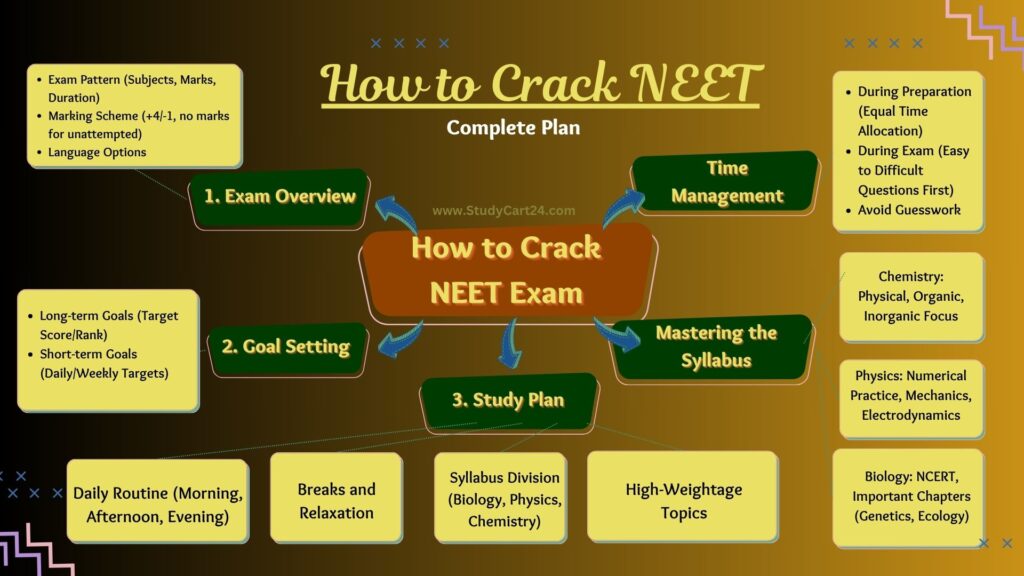
1. Exam Overview
- Exam Pattern (Subjects, Marks, Duration)
- Marking Scheme (+4/-1, no marks for unattempted)
- Language Options
2. Goal Setting
- Long-term Goals (Target Score/Rank)
- Short-term Goals (Daily/Weekly Targets)
3. Study Plan
- Daily Routine (Morning, Afternoon, Evening)
- Breaks and Relaxation
- Syllabus Division (Biology, Physics, Chemistry)
- High-Weightage Topics
4. Mastering the Syllabus
- Biology: NCERT, Important Chapters (Genetics, Ecology)
- Physics: Numerical Practice, Mechanics, Electrodynamics
- Chemistry: Physical, Organic, Inorganic Focus
5. Learning Techniques
- Active Learning (Notes, Diagrams)
- Visual Aids (Mind Maps, Flowcharts)
- Mnemonics for Memory
- Conceptual Clarity
6. Practice & Revision
- Solve Previous Year Papers
- Take Mock Tests (Simulate Exam Environment)
- Maintain Error Logs
- Weekly and Full-Length Revisions
7. Time Management
- During Preparation (Equal Time Allocation)
- During Exam (Easy to Difficult Questions First)
- Avoid Guesswork
8. Mental & Physical Health
- Healthy Diet
- Regular Exercise/Yoga
- Stress Management (Meditation)
- Adequate Sleep
9. Resources & Tools
- Books (NCERT, MTG, H.C. Verma)
- Online Platforms (Unacademy, Physics Wallah)
- Test Series (Allen, Aakash)
10. Tips for Success
- Stay Consistent & Positive
- Minimize Distractions
- Adapt Study Plan When Needed
FAQs About Cracking NEET – How to Crack NEET
How to Clear NEET in First Attempt?
Is NEET Easy to Crack?
How Can I Get 720 in NEET?
How Can I Crack NEET in First Attempt?
How Should I Score 700 in NEET?
NEET Preparation Tips?
2. Use NCERT as your primary resource.
3. Take regular mock tests to track your progress.
How Should I Prepare for the NEET?
Tips to Crack NEET Exam
II. Focus on time management during the exam.
III. Practice mock tests to improve speed and accuracy.
IV. Keep a positive attitude throughout your preparation.
Final Tips for NEET Success (How to Crack NEET)
- Stay Consistent:
- Regularity in preparation is more important than intensity.
- Stay Positive:
- Believe in your abilities and maintain a positive outlook.
- Stay Focused:
- Minimize distractions and prioritize your goals.
- Stay Adaptable:
- Be willing to adjust your study plan if you’re falling behind.
Key Resources for NEET Preparation
- Books:
- NCERT (11th and 12th) – for all subjects.
- “MTG NEET Guide” series for topic-wise preparation.
- “Objective Biology” by Dinesh for practice.
- Online Platforms:
- Platforms like Unacademy, BYJU’S, and Physics Wallah offer excellent NEET preparation materials.
- Use YouTube channels for quick conceptual videos and tips.
- Test Series:
Conclusion
Cracking NEET is a challenging yet rewarding journey. With the right strategies, resources, and mindset, you can achieve your dream of becoming a doctor. Stay disciplined, practice consistently, and keep revising. Remember, persistence and determination are the keys to success. This was our guide of tips and tricks on “How to Crack NEET”. By adopting these Tips & Tricks you may Crack NEET in First Attempt. Good luck!