Contemporary South Asia Class 12 Handwritten Notes | Political Science NCERT Chapter 3 Free PDF: Studycart24 is offering Class 12 Political Science NCERT Chapter 3 Contemporary South Asia – Free Handwritten Notes PDF, free of cost, easily downloadable, and available in a convenient PDF format for offline study. These notes follow a well-organized approach to mastering the concepts of Political Science. They are presented in a streamlined format across 15 pages, with a compact size of just a few MBs, making them ideal for revision and storage. In this article, you will find detailed insights into Chapter 3 Contemporary South Asia. Furthermore, we explore comprehensive notes, highlight important topics, provide previously asked questions, share MCQs, cover FAQs, and give useful strategies to retain information. You will also learn how to study like a topper, preview and download the notes, and prepare effectively for this chapter.
 Join Telegram
 Join WhatsApp
Download & Preview Link for Notes
| Details | Information |
|---|---|
| Chapter: | Contemporary South Asia |
| Subject: | Political Science (Contemporary World Politics) |
| Size: | 10 MB |
| Pages: | 11 |
| Format: | PDF (Scroll down below) |
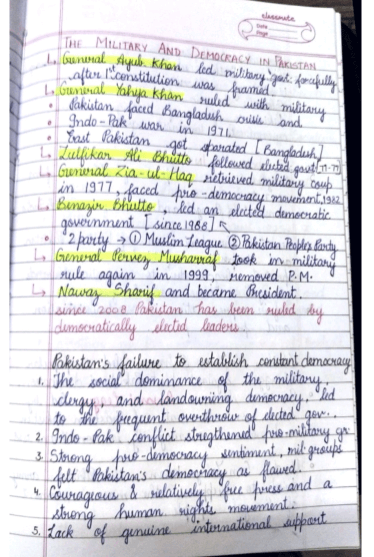
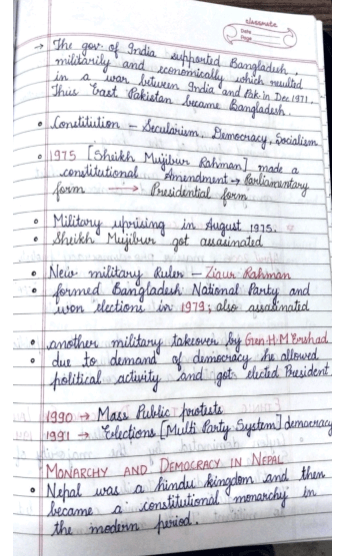
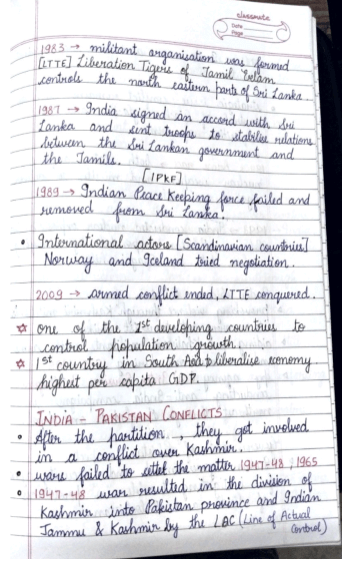
Download & Preview – Contemporary South Asia Class 12 Handwritten Notes | Political Science NCERT Chapter 3 Free PDF
| Related Notes from Studycart.com | Link |
|---|---|
| Class 12 Hindi Notes | View Here |
| Physical Education Class 12 Hindi Notes | View Here |
| Geography Class 12 Hindi Notes | View Here |
Study Aid Materials from AMAZON
Political Science Book for Class 12 | CBSE (NCERT Solved) | Examination 2025-26 | by VK Global Publications
JPH CBSE Class 12 Political Science Guide Aligned With NEP Based On Latest CBSE SYllabus
🙏 Support Our Work
We work very hard to create quality handwritten notes to support your learning journey. Every page is the result of hours of dedication and care. If you find our efforts valuable, please consider supporting us. Even a small contribution of ₹5, ₹10, ₹50, or ₹100 — whatever feels right to you — can make a big difference. Your support helps us continue this platform and keep the notes accessible to everyone. Donate securely via PhonePe – your kindness truly means a lot.

UPI ID:
(Tap to copy)
Please Donate ₹5, ₹10, ₹50, ₹100 or whatever feels right to you.
Importance of Class 12 Political Science Notes
Political Science in Class 12 introduces students to global and regional issues that shape international relations. South Asia, being a region marked by diversity, cooperation, and conflict, is one of the most important areas of study. Handwritten notes simplify these complex dynamics by condensing them into structured, exam-ready points. Instead of reading entire textbooks repeatedly, students can use these notes for quick and focused revision. In addition, they are aligned with NCERT guidelines, ensuring that all critical points are covered.
Overview of Chapter 3 Contemporary South Asia
This chapter deals with the political, economic, and social realities of South Asia after independence. It highlights the challenges faced by countries in the region, including conflict, democracy, development, and regional cooperation. By studying this chapter, students gain insight into how nations like India, Pakistan, Bangladesh, Sri Lanka, Nepal, Bhutan, and Maldives interact with each other and the world.
Key Themes Covered in the Chapter:
- Democratic experiences in South Asia – successes and challenges.
- Military and authoritarian regimes in Pakistan, Bangladesh, and other states.
- India-Pakistan conflicts and peace initiatives.
- Ethnic conflict in Sri Lanka and its consequences.
- Regional cooperation through SAARC (South Asian Association for Regional Cooperation).
- Role of India as a major power in South Asia.
- Economic and developmental challenges in the region.
Free Handwritten Notes PDF – Features
The handwritten notes for this chapter are designed to:
- Summarize each section with clarity.
- Provide diagrams, maps, and flowcharts for better understanding.
- Highlight important terms, treaties, and events.
- Include bullet points for easy revision.
- Use exam-friendly language and structure.
These features ensure that students can study more effectively and revise with confidence.
How to Study Like a Topper
Top-performing students in Political Science often rely on a systematic approach rather than rote learning. Here are some strategies to follow:
- Break the chapter into themes: Study democracy, conflicts, cooperation, and India’s role separately.
- Use comparative charts: For example, compare the political systems of India, Pakistan, and Bangladesh.
- Practice answer writing: Always structure your answers with an introduction, body, and conclusion.
- Focus on keywords: Terms like SAARC, Line of Control (LoC), Liberation Tigers of Tamil Eelam (LTTE), and Indo-Pak relations must be remembered.
- Revise regularly: Consistency ensures long-term retention.
- Connect theory to current events: For instance, relate SAARC with current regional issues.
Important Topics in Chapter 3 Contemporary South Asia
Students should concentrate on the following:
- Pakistan’s political instability and military rule.
- Democratic transition in Bangladesh.
- Civil war in Sri Lanka and the Tamil issue.
- Nepal’s shift from monarchy to democracy.
- India’s relations with Pakistan, Bangladesh, Nepal, and Sri Lanka.
- Relevance and limitations of SAARC.
- Economic cooperation and challenges in the region.
Previously Asked Questions
Here are some examples of questions asked in board exams from this chapter:
- Explain the causes of Pakistan’s political instability.
- Describe the ethnic conflict in Sri Lanka.
- Evaluate the role of SAARC in regional cooperation.
- Discuss India’s role in stabilizing South Asia.
- What are the common challenges faced by South Asian countries?
Multiple Choice Questions (MCQs)
- SAARC was established in:
- a) 1975
- b) 1985
- c) 1990
- d) 2001
- The ethnic conflict in Sri Lanka involved:
- a) Tamils and Sinhalese
- b) Hindus and Buddhists
- c) Muslims and Christians
- d) India and Pakistan
- Which country of South Asia shifted from monarchy to democracy in the 21st century?
- a) Bhutan
- b) Nepal
- c) Sri Lanka
- d) Bangladesh
- Liberation Tigers of Tamil Eelam (LTTE) demanded:
- a) A separate Tamil state in Sri Lanka
- b) Democracy in Pakistan
- c) Removal of monarchy in Nepal
- d) None of the above
- India and Pakistan fought wars in:
- a) 1947, 1965, 1971, 1999
- b) 1945, 1950, 1970, 1990
- c) 1962, 1971, 1984, 1992
- d) 1948, 1958, 1972, 1989
FAQs on Contemporary South Asia
Because it is home to nearly a quarter of the world’s population, has nuclear powers like India and Pakistan, and plays a major role in global trade and security.
They face political instability, poverty, terrorism, ethnic conflicts, and regional disputes.
SAARC promotes regional cooperation in trade, culture, education, and development, though its progress is often slowed by Indo-Pak tensions.
Nepal transitioned from a monarchy to a democratic republic, facing internal struggles but strengthening democratic institutions.
India acts as a stabilizing force, supports democratic transitions, and promotes regional development while managing conflicts with neighbors.
How to Prepare for Class 12 Political Science NCERT Chapter 3 Contemporary South Asia
Follow these steps for efficient preparation:
- Read the NCERT chapter thoroughly: Understand the basic storyline.
- Highlight and note down keywords: Mark important treaties, years, and terms.
- Use handwritten notes: Revise quickly and effectively.
- Solve practice questions: Write both short and long answers.
- Refer to previous year question papers: Identify recurring themes.
- Stay updated with current affairs: Connect regional issues with ongoing developments.
Final Tips to Score High in Political Science
- Write structured answers with headings and examples.
- Practice using maps and flowcharts for clarity.
- Revise regularly to avoid last-minute stress.
- Link theoretical knowledge with real-world issues.
- Manage time efficiently during the exam.
Conclusion – Class 12 Political Science NCERT Chapter 3 Contemporary South Asia
The chapter Contemporary South Asia is crucial for understanding the political and social challenges of the region. It explains democratic struggles, ethnic conflicts, India’s role, and the importance of regional cooperation through SAARC. With Studycart24’s free handwritten notes PDF, students get a compact yet detailed resource to master the chapter. By practicing MCQs, reviewing previous year questions, and applying topper strategies, learners can prepare effectively and score full marks. Download the notes today and make your preparation smarter and more organized.
Tags: Class 12 Political Science Chapter 3 Contemporary South Asia,
Contemporary World Politics Class 12 NCERT Notes,
Political Science Part 1 Class 12 Contemporary South Asia,
NCERT Class 12 Political Science Contemporary South Asia Summary,
CBSE Class 12 Political Science Handwritten Notes PDF,
Studycart24 Free Handwritten Notes Class 12 Political Science,
Toppers Class Notes Political Science Chapter 3 Class 12,
Class 12 CBSE Exams Political Science Chapter 3 Notes,
NCERT Solutions for Class 12 Political Science Contemporary South Asia,
Download Free Handwritten PDF Class 12 Political Science Chapter 3