
Class 10 Maths Chapter 9 PDF: Applications of Trigonometry forms a critical part of the Class 10 Maths syllabus. It not only builds the foundational skills needed for advanced mathematics but also offers real-world relevance in fields such as engineering, architecture, astronomy, and physics. To facilitate your learning experience, we proudly provide you — Free of Cost — easily downloadable Handwritten Notes in PDF Format. These notes are ideal for offline study and present a well-organized approach to mastering Trigonometry concepts.
 Join Telegram
 Join WhatsApp
Our detailed notes in English are curated across neatly structured 6 pages. They are incredibly compact, with a file size of just 1.5 MB, making them perfect for quick downloads and mobile-friendly study sessions. In this comprehensive article, you will gain valuable insights about Chapter 9: Applications of Trigonometry. Furthermore, we delve into the features of these notes, provide a preview, share a download link, highlight important topics, and include previously asked questions, one-liners with answers, FAQs, and exam-targeted tables. Let’s explore how you can ace this chapter with confidence.
Key Features of Chapter 9: Applications of Trigonometry Class 10 – Handwritten Notes
| Subject : | Mathematics |
| Class: | 10th |
| Chapter: 9 | Applications of Trigonometry (Class 10 Maths Chapter 9 PDF) |
| Size: | 1.5 MB |
| Pages: | 6 |
| Language: | English |
| Format: | PDF (click the download button in the section below |
Preview and Download Link of Chapter 9: Applications of Trigonometry Class 10
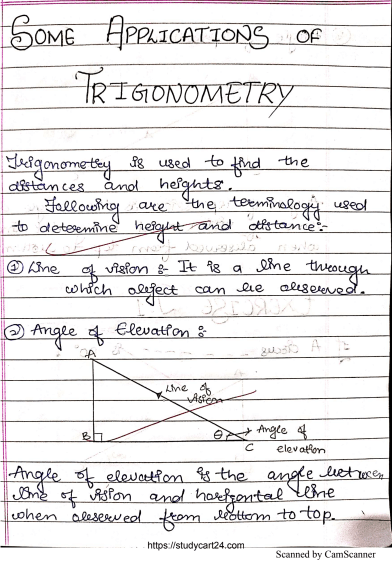
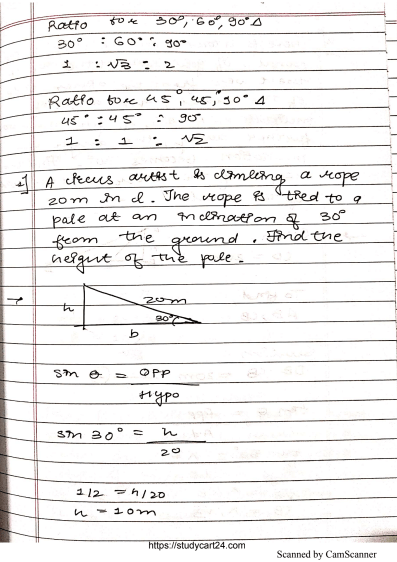
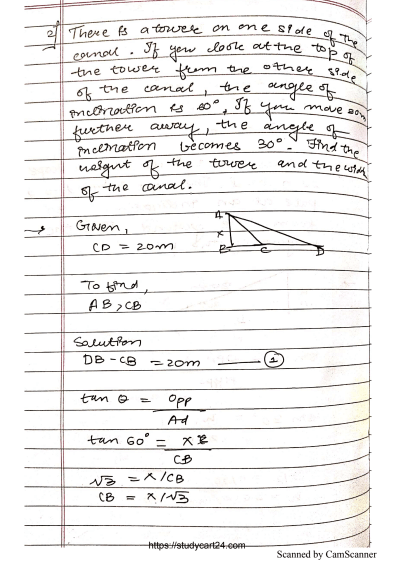
Images of Class 10 Maths Chapter 9 PDF: Applications of Trigonometry Class 10 – Free Handwritten Notes PDF
| Related Free Notes from Studycart24.com | Links |
|---|---|
| Chapter 5: History – Print Culture and the Modern World Class 10 Notes | View Here |
| Chapter 2: Units and Measurements Class 11 Notes (PHYSICS) Handwritten PDF for Free in English | View Here |
| Chapter 4: History – The Age of Industrialization Class 10 Notes PDF in English | Free Download | View Here |
Other Recommended Resources from AMAZON
| Amazon Resources – Study Materials | Product Links |
|---|---|
| Secondary School Mathematics for Class 10 – CBSE – by R.S. Aggarwal Examination 2025-26 Paperback | Click Here |
| Physics Wallah PW CBSE Question & Concept Bank (QCB) Class 10 Science Chapter-wise and Topic-wise Solved Questions For 2026 Exams with 50% Competency Based Question | Click Here |
🙏 Support Our Work
We work very hard to create quality handwritten notes to support your learning journey. Every page is the result of hours of dedication and care. If you find our efforts valuable, please consider supporting us. Even a small contribution of ₹5, ₹10, ₹50, or ₹100 — whatever feels right to you — can make a big difference. Your support helps us continue this platform and keep the notes accessible to everyone. Donate securely via PhonePe – your kindness truly means a lot.

UPI ID:
(Tap to copy)
Please Donate ₹5, ₹10, ₹50, ₹100 or whatever feels right to you.
How to Prepare for Chapter 9: Applications of Trigonometry
Step 1: Understand the Basics
Begin with understanding the foundational concepts:
- Angle of elevation and depression
- Trigonometric ratios
- Line of sight
- Right-angled triangle geometry
Step 2: Learn Through Visualization
Use diagrams and real-world examples to grasp applications like:
- Measuring the height of a tree or building using shadow length
- Calculating distances that are otherwise difficult to measure directly
Step 3: Practice Variety of Questions
Cover the full range of question types, such as:
- Direct formula-based
- Conceptual
- Real-life scenario-based
Step 4: Revise Frequently
Repetition is key to mastering trigonometry. Use the one-liners and solved questions from our notes to reinforce your memory.
Important Formulas to Remember
Here’s a list of must-know formulas from Chapter 9:
| Quantity | Formula | Description |
|---|---|---|
| Height (h) | h=d⋅tan(θ)h = d \cdot \tan(\theta) | h = height, d = base distance, θ = angle of elevation |
| Base (d) | d=htan(θ)d = \frac{h}{\tan(\theta)} | Reverse of the height formula |
| Complementary Angles | tan(90∘−θ)=cot(θ)\tan(90^\circ – \theta) = \cot(\theta) | Useful when angle depression is used |
| Angle of Elevation/Depression | Found using trigonometric ratios | Use right triangle properties |
Use these formulas extensively while solving exercises from the textbook and previous papers.
Previously Asked Questions from Chapter 9: Applications of Trigonometry Class 10
Below are some past year board questions that have been frequently repeated:
- A ladder leaning against a wall makes a 60° angle with the ground. The foot of the ladder is 4 meters away from the wall. Find the height it reaches on the wall.
- The angle of elevation of the top of a tower from a point on the ground is 30°. If the height of the tower is 50 m, find the distance of the point from the base of the tower.
- From a point 20 m above the ground, the angle of depression of the foot of a tower is 45°. Find the height of the tower.
These questions test your ability to draw diagrams, use correct trigonometric ratios, and interpret angles correctly.
Questions That May Come in Exams – Chapter 9: Applications of Trigonometry
Anticipating what might come can give you an edge:
- The angle of elevation of the top of a building from a point A on the ground is 45°. If the point A is 30 meters away from the base, find the height of the building.
- A kite is flying at a height of 60 meters. If the angle of elevation of the kite from the ground is 30°, find the length of the string.
- A student observes the top of a water tank from a certain distance making a 60° angle of elevation. If the tank is 10 m tall, find the distance from the point of observation.
One-Liners with Answers from Chapter 9: Applications of Trigonometry
Boost your revision with these high-impact one-liners:
- Q: What is the angle of elevation?
A: The angle formed between the line of sight and the horizontal when the object is above the observer. - Q: Which ratio is used when height and base are known?
A: tan(θ)=heightbase\tan(\theta) = \frac{\text{height}}{\text{base}} - Q: Can angle of depression ever be more than 90°?
A: No, it always lies between 0° and 90°. - Q: What do trigonometric applications require?
A: A right-angled triangle scenario.
Important Tables
To quickly revise during exams, use this handy reference table:
Standard Trigonometric Values
| Angle | sin θ | cos θ | tan θ |
|---|---|---|---|
| 0° | 0 | 1 | 0 |
| 30° | 1/2 | 3/2\sqrt{3}/2 | 1/31/\sqrt{3} |
| 45° | 1/21/\sqrt{2} | 1/21/\sqrt{2} | 1 |
| 60° | 3/2\sqrt{3}/2 | 1/2 | 3\sqrt{3} |
| 90° | 1 | 0 | Not Defined |
Frequently Asked Questions (FAQs)
Yes, it frequently contributes 3–5 marks and tests real-world application understanding.
Absolutely. These notes are comprehensive and aligned with NCERT patterns.
Yes, the notes include fully solved examples with step-by-step procedures.
Yes, from aviation and construction to astronomy, it is widely used.
Definitely. With consistent practice and the right strategy, it’s achievable.
Conclusion Chapter 9: Applications of Trigonometry Class 10 – Free Handwritten Notes
Chapter 9: Applications of Trigonometry, though brief in the textbook, is packed with high-yield concepts. It holds immense value not only for Class 10 board exams but also in practical scenarios across disciplines. These Free Handwritten Notes in PDF Format are meticulously curated to enhance your learning and exam preparation. With formula charts, solved questions, smart one-liners, and FAQs — you have everything needed to ace this chapter.
tags:
CBSE Board exam class 10,
NCERT class 10 Maths notes,
Download free class 10 notes,
class 10 Mathematics chapter 9,
Applications of Trigonometry notes,
Free study materials for class 10,
class 10 board exam preparation,
studycart24.com class 10 resources,
Download Free Class 10 Maths notes,
Free Handwritten Notes Chapter 9 applications of trigonometry,
Some Applications of Trigonometry Class 10 PDF,
some applications of trigonometry class 10 notes pdf,

