
Linear Inequalities Class 11 NCERT Solutions: Studycart24 is offering “Chapter 5: Linear Inequalities NCERT Class 11 Maths Solution – Free Handwritten PDF”, easily downloadable in PDF format for offline study, and a well‑organized approach to mastering inequalities concepts. These detailed solutions in English are presented in a streamlined layout across 24 pages; a compact size of just ~9 MB. In this article, you’ll find detailed insights about Chapter 5: Linear Inequalities, as well as explore the features of these notes, get a preview, learn important topics, review previously asked questions, discover one‑liners with answers, FAQs, helpful tables, and preparation tips—all designed to help you excel and make learning fun for teenagers!
 Join Telegram
 Join WhatsApp
| Overview | Details |
|---|---|
| Subject: | Mathematics |
| Class | 11 |
| Chapter: | Linear Inequalities |
| Size: | 9 MB |
| Pages | 24 |
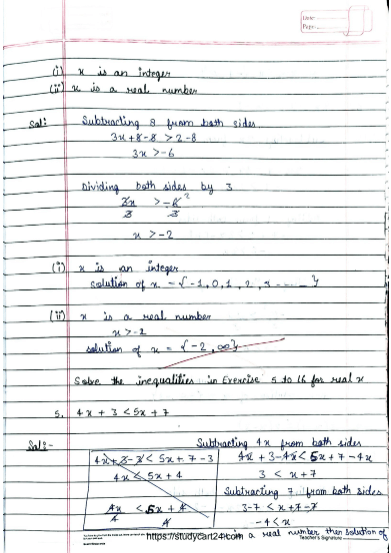
Preview Download Link of Chapter 5: Linear Inequalities ClassLinear Inequalities NCERT Class 11 Maths Solution PDF


Recommended Materials from AMAZON
Arihant CBSE Chapterwise Question Bank 2025–2016 for Class 12 Mathmatices | Latest Syllabus | Includes Solved Papers, Sample Papers, and CBSE Marking Scheme Paperback –

Gurukul By Oswal Mathematics Most Likely CBSE Question Bank for Class 11 Exam 2026 – Chapterwise & Categorywise, Competency Focused Qs, NCERT Qs and Exemplars, Case, Assertion & Reasoning
Why Do You Need linear inequalities class 11 ncert solutions?
First and foremost, a free and downloadable PDF lets you study offline anytime—ideal for long travels, classes with limited internet, or quick review before exams. Secondly, handwritten notes bring a personal touch: they mimic classroom chalkboard style, which feels more relatable and less intimidating than typed content. Additionally, these notes are concise yet complete, focusing only on essential concepts and formulas. As a result, they save time and emphasize retention. Moreover, the visually engaging layout—with highlighted boxes, sketches of number lines, and solved examples—makes learning engaging rather than tedious. Ultimately, these notes help you stay organized, confident, and exam-ready.
🙏 Support Our Work
We work very hard to create quality handwritten notes to support your learning journey. Every page is the result of hours of dedication and care. If you find our efforts valuable, please consider supporting us. Even a small contribution of ₹5, ₹10, ₹50, or ₹100 — whatever feels right to you — can make a big difference. Your support helps us continue this platform and keep the notes accessible to everyone. Donate securely via PhonePe – your kindness truly means a lot.

UPI ID:
(Tap to copy)
Please Donate ₹5, ₹10, ₹50, ₹100 or whatever feels right to you.
How to Prepare for This Chapter
- Understand the Basics First: Ensure you’re comfortable with algebraic expressions and solving linear equations. This foundation makes inequalities a breeze.
- Learn Graphical Representation: Practice sketching inequalities on a number line; shading left or right depending on the inequality sign is fun and visual.
- Follow Step-by-Step Examples: Use the notes’ solved examples; try rewriting each step in your own words to reinforce understanding.
- Practice Boundary Tests: Plug in numbers just inside and outside solution sets to verify your shaded regions.
- Memorize Key Rules: For instance, when multiplying or dividing by a negative, inequality flips direction—a small detail that often trips up students!
- Do Practice Problems: Use the built-in practice questions and time yourself as though in an exam.
- Self‑test With One‑Lin ers: Quickly quiz yourself using the one‑liner answers section from the notes.
- Group Study or Teach a Friend: Explaining concepts aloud helps you internalize them well.
With regular revision and smart practice, you’ll be solving inequalities like a pro.
Important Formulas & Concepts: Linear Inequalities Class 11 NCERT Solutions
Here are the key concepts and formulas you must master:
Definition & Basic Types
- Linear inequality in one variable: ax + b > 0 (or <, ≥, ≤)
- Solution set: Interval notation like (–∞, –b/a), [–b/a, ∞), depending on signs
Solving Techniques
- Simple algebraic approach: transposition, combining like terms
- Handling signs: multiply both sides by –1 → flip the inequality direction
- Compound inequalities: a < x < b treated as two separate inequalities
- Graphical method: plotting boundary point and shading side
Interval Notations
- Open interval: (a, b) means a < x < b
- Closed interval: [a, b] means a ≤ x ≤ b
- Half‑open intervals like [a, b) or (a, b]
Number‑Line Rules
- ≥ or ≤ includes the boundary (solid dot on number line)
- > or < excludes the boundary (open dot)
Combined Formulas
- If multiplying/dividing by a negative number: eg. –2x > 6 → x < –3 (inequality flips)
- Breaking compound: a ≤ x < b → solution set is the overlap of x ≥ a and x < b
Previously Asked Questions from This Chapter
Here are some commonly seen exam‑style questions that appeared in board exams or sample papers:
- “Solve the inequality: 3x – 7 ≤ 2(x + 5) – x”
- “Solve and graph: (2x + 1)(x – 3) ≥ 0”
- “Write solution set for 5 – 2x > 1 and represent it on a number line”
- “Solve compound inequality: –2 ≤ 2x – 3 < 5”
These questions typically involve multi-step reasoning and require you to manage algebra carefully—exactly the style you’ll find in the handwritten notes, complete with explanations and boundary graphs.
Useful Tables: Linear Inequalities Class 11 NCERT Solutions
Formula Summary Table – NCERT Class 11 Maths Solution
| Technique | Rule / Formula |
|---|---|
| Multiply/divide by positive | Inequality sign stays the same |
| Multiply/divide by negative | Flip the sign (e.g. > → <) |
| Compound “and” | Solve separately, then intersect |
| Compound “or” | Solve separately, then union results |
| Represent ≥ or ≤ on number line | Solid dot; shade outward |
| Represent > or < on number line | Open dot; shade outward |
Practice Problem Reference Table
| Problem Type | Page No. in PDF | Skill Tested |
|---|---|---|
| Simple linear inequality | 3–4 | Transposition |
| Multiplying negatives | 5–6 | Inequality flipping |
| Compound inequalities (“and”) | 8–10 | Overlap/intersection |
| Graphing on number line | 11–13 | Visual representation |
These tables help you navigate the notes quickly and focus on weak areas.
Summary -Linear Inequalities Class 11 NCERT Solutions
In summary, Studycart24’s “Chapter 5: Linear Inequalities Class 11 Maths Solution – Free Handwritten Notes in PDF” is an excellent resource for students seeking clarity, engagement, and focus. It’s completely free, easy to download, and cleverly styled to make inequalities understandable and enjoyable. Your learning journey becomes smoother when using well‑structured explanations, worked examples, boundary tests, and quick‑revision sections.
More FAQs: Linear Inequalities Class 11 NCERT Solutions PDF
A: Yes, they cover all typical CBSE Class 11 Linear Inequalities topics, formulas, solved examples, and sample questions likely to appear in exams.
A: Absolutely! The PDF is small (~1.2 MB), so printing or sharing with classmates is hassle‑free.
A: No. These notes are completely free with no sign‑up needed.
A: Currently, Studycart24 offers only the handwritten PDF, but it’s crafted to be direct and effective without extra fluff.
A: Certainly! Concepts of inequalities appear in many competitive exams like engineering or entrance tests. Practicing these notes sharpens algebraic thinking.
Tips to Make Your Study Fun
- Draw doodles or emotive stick‑figures next to examples to lighten the mood.
- Color‑code your number lines (e.g. red for ≥, blue for >) to differentiate.
- Convert one‑liners into flashcards you can review while commuting or waiting.
- Challenge a friend: time each other solving an inequality problem and keep a scoreboard.
Final Motivation – NCERT Class 11 Maths Solution NOTES
embrace the chapter as a puzzle rather than a chore—every inequality is a little challenge waiting to be cracked. With these neat handwritten notes in hand, you get clarity, conciseness, and confidence all rolled into one. By reviewing examples, memorizing the key one‑liners, and practicing with the tables and previously asked questions, you’re setting yourself up for test success. So download the PDF, grab your highlighter, and let’s dominate Chapter 5 together!
Happy studying, and may your marks be as positive and unbounded as your solution sets!
Tags:
Class 11 Maths NCERT Solutions,
Handwritten Notes for Class 11 Maths,
CBSE Class 11 Linear Inequalities,
Studycart24 Maths Notes PDF,
Free Download Class 11 Maths Notes,
Toppers Class Notes for Linear Inequalities,
Chapter 5 Linear Inequalities Class 11,
Board Exam Preparation Class 11 Maths,
Competitive Exams Maths Notes,
NCERT Linear Inequalities Handwritten PDF,
Linear Inequalities Class 11 Graphs and Formulas,
CBSE Maths Notes Free PDF,
Class 11 Maths Chapter 5 Solutions,
Studycart24 Handwritten Notes Maths,
Quick Revision Notes Class 11 Linear Inequalities.
Linear Inequalities Class 11 NCERT Solutions,
Class 11 Maths Solutions,
class 11 maths ncert solutions pdf,

