The Voice of the Rain Question Answer: Class 11 English Hornbill: Studycart24 is offering Class 11 English Hornbill Question Answers – Poem 3: The Voice of the Rain, Free of Cost, easily downloadable Handwritten Notes in a PDF Format for offline study, and a well-organized approach to mastering concepts. These detailed notes in English are presented in a streamlined format across 4 pages, with a compact size of just 5 MBs, making them portable and easy to revise anytime. In this article, you will find detailed insights into Poem 3: The Voice of the Rain. Furthermore, we explore the summary of the poem, highlight important topics, provide previously asked questions, share FAQs, and include study strategies to retain knowledge effectively.
 Join Telegram
 Join WhatsApp
| Info | Details |
|---|---|
| Chapter | Poem 3: The Voice of the Rain |
| Subject | English |
| Pages | 4 |
| Size | 5 MB |
| Format |
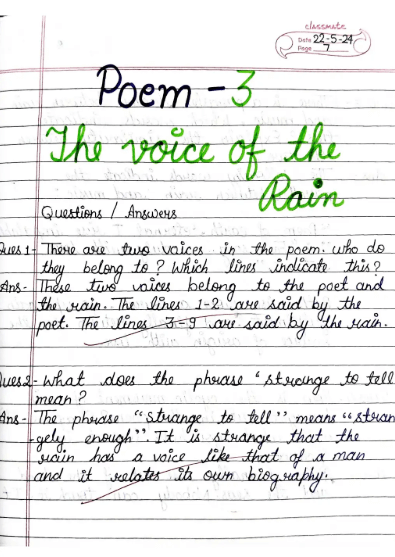
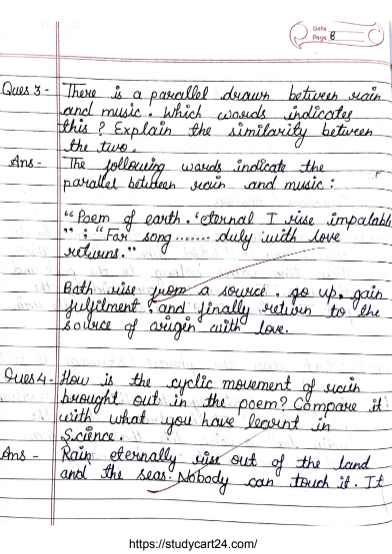
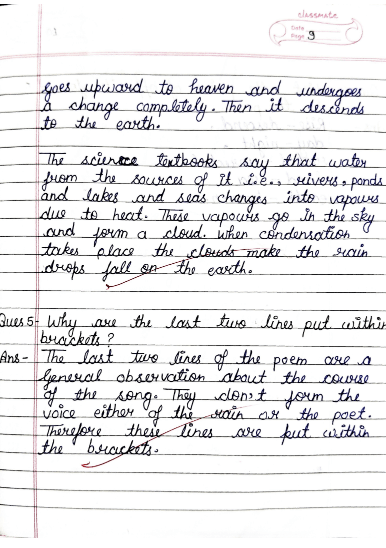
Download & Preview of The Voice of the Rain Question Answer
Related Notes from Studycart24.com for Class 11th
- Physics Class 11 Notes
- Chemistry Class 11 Notes
- Mathematics Class 11 Notes
- Biology Class 11 Notes
- Computer Science Class 11 Notes
- Mathematics Class 11 Notes
- Physical Education Class 11 Notes
Booster Study Materials from AMAZON
SUBHAS PUBLISHING HOUSE PVT. LTD. Super Companion 5 in 1 Series English Guide / Study Material Book, Question Bank with Question and Solved Answers For 1st PU / Class 11 Examination
All In One Class 11th English Core for CBSE Exam 2024
🙏 Support Our Work
We work very hard to create quality handwritten notes to support your learning journey. Every page is the result of hours of dedication and care. If you find our efforts valuable, please consider supporting us. Even a small contribution of ₹5, ₹10, ₹50, or ₹100 — whatever feels right to you — can make a big difference. Your support helps us continue this platform and keep the notes accessible to everyone. Donate securely via PhonePe – your kindness truly means a lot.

UPI ID:
(Tap to copy)
Please Donate ₹5, ₹10, ₹50, ₹100 or whatever feels right to you.
About the Poem – The Voice of the Rain
The Voice of the Rain is a short yet profound poem written by Walt Whitman, one of the most celebrated American poets. The poem appears in the Class 11 Hornbill English textbook and is valued for its symbolic depth and musical quality.
Whitman presents rain not just as a natural phenomenon but as a living entity with a “voice.” The rain speaks to the poet, explaining its cycle: it rises from the land and sea, transforms into clouds, and returns to earth to nourish life. The poet captures the eternal bond between nature and human life, emphasizing regeneration, continuity, and harmony.
Because of its unique structure and personification of rain, this poem often becomes a favorite in exams, where students are asked to analyze symbolism, write summaries, or explain the conversational style of poetry.
Summary of The Voice of the Rain
The poem unfolds as a dialogue between the poet and the rain. When the poet asks, “And who art thou?” the rain replies that it is the poem of the Earth. It rises unseen from the land and sea, floats in the sky, transforms into clouds, and falls back to the surface to cleanse, nurture, and enrich life.
Whitman compares the rain to a song – just as a song originates from the heart of the poet, travels across the world, and returns with appreciation, the rain originates from the Earth and comes back to complete its purpose.
In essence, the poem blends science, spirituality, and art, portraying rain as a metaphor for the continuous cycle of life.
Stanza-Wise Explanation of The Voice of the Rain
- Opening Question
- The poet asks the rain to identify itself. Surprisingly, the rain responds.
- This introduces the central idea of personification.
- The Reply of the Rain
- The rain identifies itself as the poem of the Earth.
- It rises invisibly from oceans and lands, forming clouds.
- Cycle of Return
- Rain showers return to the ground, purifying and nourishing life.
- The cycle is eternal, symbolizing continuity.
- Comparison with Song
- The rain’s journey is compared with a song created by a poet.
- Both bring joy, renewal, and fulfillment when they return.
This breakdown not only simplifies the poem but also helps students frame answers effectively in examinations.
How to Study Like a Topper
Toppers don’t just read the poem; they internalize it. Here’s how you can study like them:
- Visualize the Poem: Imagine the rain’s cycle – evaporation, clouds, rainfall – and link it to Whitman’s comparison with song.
- Focus on Literary Devices: Personification and metaphor are heavily tested.
- Create Micro-Notes: Write down themes in 3–4 bullet points for last-minute revision.
- Practice Past Papers: Previous board exams often repeat questions in varied forms.
- Use Mnemonics: For example, “RSCN” = Rise, Sky, Clouds, Nurture to remember the rain’s journey.
By adopting these strategies, toppers save time, reduce stress, and retain information longer.
How to Prepare for This Chapter (The Voice of the Rain Question Answer)
Here’s a stepwise preparation method:
- Read Aloud – Since the poem has a song-like rhythm, reading aloud helps.
- Mark Important Lines – Lines like “I am the poem of the Earth” are commonly quoted in exams.
- Summarize in Your Own Words – Practice writing summaries in 100–150 words.
- Revise Daily – Short daily revisions are better than cramming before exams.
- Link with Science – Relating the poem to the water cycle helps solidify memory.
This approach ensures clarity and makes preparation stress-free.
Important Topics and Literary Devices in The Voice of the Rain
- Themes:
- The water cycle as a symbol of renewal.
- Relationship between Earth and rain.
- Parallels between nature and art.
- Spiritual harmony and continuity.
- Literary Devices:
- Personification – Rain speaks as if it were alive.
- Metaphor – Rain compared to a poem/song.
- Imagery – Visuals of clouds, rain, nurturing earth.
- Symbolism – Rain as a symbol of life and creativity.
- Tone: Lyrical, reflective, and conversational.
Important Formulas and Memory Tricks
While English doesn’t have formulas, you can use simple tricks:
- RAIN = Renewal, Art, Inspiration, Nature
- SONG = Source, Origin, Nurture, Growth
These acronyms can help you quickly recall the essence of the poem.
Previously Asked Questions from The Voice of the Rain
- What does the rain call itself in the poem?
- How is the journey of rain compared to a song?
- Write the central theme of The Voice of the Rain.
- How does the poem depict the cycle of life?
- Explain the significance of the line “I am the poem of the Earth.”
More FAQs on The Voice of the Rain Question Answer
You should definitely try reading textbook once, there’s noo shortcut but if you’re in a hurry, then go for it.
They are handwritten by subject experts and carefully designed for exam preparation.
The notes span 15 pages, covering summary, questions, and key points.
Yes, completely free without hidden charges.
These notes are structured for last-minute preparation.
Tables for Quick Learning
| Element | Details from The Voice of the Rain |
|---|---|
| Poet | Walt Whitman |
| Central Theme | Cycle of rain, renewal, art & nature |
| Tone | Lyrical, reflective |
| Key Symbolism | Rain = Poem of the Earth |
| Important Literary Devices | Personification, Metaphor, Imagery |
Final Thoughts – The Voice of the Rain Question Answer
The Voice of the Rain by Walt Whitman is a beautiful blend of science, philosophy, and art. By giving rain a “voice,” the poet transforms a natural process into a symbol of life, continuity, and creativity. For students of Class 11, mastering this poem is essential not only for exams but also for appreciating literature more deeply.
The free handwritten notes PDF from Studycart24 makes preparation much easier. With summaries, previous year questions, literary devices, and FAQs, these notes offer everything needed for revision in a compact format.
Whether you want to study like a topper, prepare for board exams, or simply understand the poem better, these notes and strategies will guide you. Download the PDF, revise regularly, and step into exams with confidence.
Tags: class 11 English Hornbill Poem 3 The Voice of the Rain Question Answers,
The Voice of the Rain Poem Class 11 English Hornbill Notes,
Class 11 English Hornbill Poem 3 NCERT Solutions PDF,
CBSE Class 11 English Hornbill Poem Handwritten Notes,
Studycart24 Class 11 English Handwritten Poem Notes,
Class 11 English Hornbill The Voice of the Rain Question Answer Handwritten PDF,
Toppers Class Notes for Class 11 English Poem The Voice of the Rain,
Class 11 CBSE Exams English Hornbill Poem 3 The Voice of the Rain,
NCERT Solutions The Voice of the Rain Poem Class 11 English Notes,
Download Free Handwritten PDF Class 11 English Hornbill Poem,
Class 11 English Hornbill Poem 3 The Voice of the Rain Handwritten Solutions,
CBSE Board Exam English Hornbill Poem The Voice of the Rain Notes,
Class 11 English Handwritten Notes for CBSE Poem 3,
Best Notes for Class 11 English Hornbill Poems Studycart24,
The Voice of the Rain Poem Summary and Question Answers Class 11
The Voice of the Rain Question Answer