
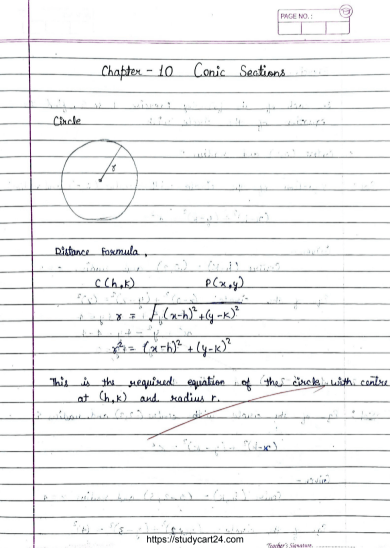
Chapter 10: Conic Sections Class 11 Ncert Solutions PDF Download – Best Maths Handwritten Notes: studycart24 is offering Chapter 10: Conic Sections NCERT Class 11 Math Solutions, Free of Cost, easily downloadable Handwritten Solutions in a PDF Format for offline study, and a well‑organized approach to mastering concepts. These detailed Solutions in English are presented in a streamlined format across 50 pages; a compact size of just 19 MB —so you can take them anywhere! In this article, you will find detailed insights about Chapter 10: moreover, we explore the features of these notes, provide a preview, share important topics, previously asked questions, FAQs, and useful tables to help you excel in your exam preparation.
 Join Telegram
 Join WhatsApp
| Overview | Details |
|---|---|
| Subject: | Mathematics |
| Class | 11 |
| Chapter: | 10: Conic Sections |
| Size: | 19 MB |
| Pages | 50 |
Preview and Download Link of Conic Sections Class 11 Ncert Solutions


| Related Notes | View URL |
|---|---|
| Chapter 7: System of Particles and Rotational Motion Class 11 Notes PDF (Physics) in English | View Here |
| Chapter 11: Thermal Properties of Matter Class 11 Notes -Physics FREE Handwritten Notes PDF Download | View here |
Relevant Study Materials from AMAZON
CBSE Class 11 MATHS Short Revision Notes for Term 1
MTG Objective NCERT at your FINGERTIPS Mathematics For 2025-2026 Exam – NCERT JEE Trend Indicator, HOTS MCQs, Rank Predictor & Notes with HD Pages | JEE Books (Based on NCERT Latest Pattern)
Why Do You Need Chapter : 10 Conic Sections Class 11 Ncert Solutions?
Let’s be real—it’s way more fun and effective when your notes feel personal. These handwritten notes are vibrant, clear, and packed with the right kind of energy to keep any teen engaged. Instead of staring blankly at textbook pages, you’ll get diagrams, side-by-side derivations, and step-by-step solutions that look like they came from a friendly senior (or your super‑cool math buddy). As a bonus, having them in PDF means:
- You can highlight, scribble, and make side‑notes in your digital reader.
- Offline study becomes possible even when your phone’s out of charge or the net is down.
- They’re compact, so no dragging around a thick textbook when you head to the library or your bestie’s place.
Plus, handwritten notes can boost retention because they’re more relatable—just like hearing a friend explain it over chai and samosas!
🙏 Support Our Work
We work very hard to create quality handwritten notes to support your learning journey. Every page is the result of hours of dedication and care. If you find our efforts valuable, please consider supporting us. Even a small contribution of ₹5, ₹10, ₹50, or ₹100 — whatever feels right to you — can make a big difference. Your support helps us continue this platform and keep the notes accessible to everyone. Donate securely via PhonePe – your kindness truly means a lot.

UPI ID:
(Tap to copy)
Please Donate ₹5, ₹10, ₹50, ₹100 or whatever feels right to you.
How to Prepare for Conic Sections Class 11 Ncert Chapter
1. Start with the Basics
Begin by reading definitions. Understand what a conic section is: the intersection of a plane and a cone. Visualize each curve—parabola, ellipse, hyperbola—by sketching them yourself. A visual refresher helps your mind grasp why things behave the way they do.
2. Memorize Standard Forms
With some light mix of flashcards and written repetition, commit to memory the standard forms:
- Parabola: y2=4axy^2 = 4ax or x2=4ayx^2 = 4ay
- Ellipse: x2a2+y2b2=1\frac{x^2}{a^2} + \frac{y^2}{b^2} = 1
- Hyperbola: x2a2−y2b2=1\frac{x^2}{a^2} – \frac{y^2}{b^2} = 1
Once they stick, you’ll breeze through many problems. The notes illustrate them side-by-side so you can “see” the differences.
3. Dive into Properties
Explore each curve’s focus, directrix, eccentricity ee, latus rectum, and axis properties. Our notes use bullets, arrows, and small diagrams to show you what changes when e>1e>1 or e<1e<1. Engage with these ideas: picture the shape in your mind.
4. Practice Derivations
We don’t just give you the formulae—we derive them. By following the handwritten deduction, you’ll understand why the formula for focus and directrix makes sense rather than memorizing blindly. Then try deriving them yourself, using those guided steps as a help.
5. Solve Sample Questions
Your PDF includes solved questions with clear commentary like “beauty tip: simplify early to avoid messy algebra” and “fresh eyes trick: always check if you’ve used the squared variable right.” After each example, pause to reproduce it on your own before moving on.
6. Use Tables for Quick Review
The end of the PDF shows summary tables for:
- Standard forms
- Focus-directrix-eccentricity relationships
- Latus rectum lengths
- Major/minor axes in ellipses/hyperbolas
These tables are perfect just before a test or when you’re revising.
7. Test Yourself
After studying the PDF, challenge yourself: grab 5–6 questions from previous NCERT exemplar problems or online compilations. Try solving without notes. Then, compare your solutions against the notes to check areas you can sharpen.
8. Mix in Fun Activities
- Draw by hand each conic on graph paper, adding your own color code for axes, asymptotes, foci, etc.
- Create a “Conic Card Deck”: On one side draw the diagram or write the equation, and on the other side list properties. Test yourself or your friends.
- Gamify it: Time yourself—can you rewrite the properties of an ellipse in under 30 seconds? High-five if you can!
Important Formulas: Conic Sections Class 11 Ncert Solutions
Below are some of the most vital formulas, written playfully like you’d highlight them in your notes:
Parabola
- Standard form: y2=4axy^2 = 4ax, with focus (a,0)(a,0), directrix x=−ax=-a, latus rectum 4a4a.
- Or: x2=4ayx^2 = 4ay, focus (0,a)(0,a), directrix y=−ay=-a, latus rectum 4a4a.
Ellipse
- Standard form: x2a2+y2b2=1\frac{x^2}{a^2} + \frac{y^2}{b^2} = 1 (with a>ba > b).
- Foci: (±c,0)(\pm c,0) where c2=a2−b2c^2 = a^2 – b^2.
- Eccentricity e=cae = \frac{c}{a}.
- Directrices: x=±aex = \pm \frac{a}{e}.
- Latus rectum length: 2b2a\frac{2b^2}{a}.
Hyperbola
- Standard form: x2a2−y2b2=1\frac{x^2}{a^2} – \frac{y^2}{b^2} = 1.
- Foci: (±c,0)(\pm c, 0) where c2=a2+b2c^2 = a^2 + b^2.
- Eccentricity e=cae = \frac{c}{a} (always >1).
- Directrices: x=±aex = \pm \frac{a}{e}.
- Latus rectum length: 2b2a\frac{2b^2}{a}.
General Tips
- For rotated conics or general second-degree equations (like Ax2+Bxy+Cy2+Dx+Ey+F=0Ax^2 + Bxy + Cy^2 + Dx + Ey + F = 0), first check if B=0B=0. Then complete the square to reduce it to a standard form.
- Use a table or checklist whenever you analyze a new conic.
Previously Asked Questions from Conic Sections Chapter
To help you prep like a champ, here are some real or typical NCERT/board exam questions about conic sections, plus glimpses of how the notes tackle them:
- Prove that the locus of a point that moves so that the sum of its distances from two fixed points (foci) is constant is an ellipse.
- The notes sketch this gorgeously—first you label F₁, F₂, take coordinates, set up (x‑c)2+y2+(x+c)2+y2=2a\sqrt{(x‑c)^2 + y^2} + \sqrt{(x + c)^2 + y^2} = 2a, square twice, and simplify. At the end, you reach x2a2+y2b2=1\frac{x^2}{a^2} + \frac{y^2}{b^2}=1. It’s like unraveling a fun mystery in math, and your handwritten friend walks you through it, side‑by‑side.
- Show that the eccentricity of an ellipse is always less than 1, and that of a hyperbola always greater than 1.
- With the notes, you see a boxed statement: “Since c2=a2−b2, c<a⇒e=c/a<1c^2 = a^2 – b^2,\; c < a ⇒ e = c/a < 1” for ellipses, and similarly for hyperbolas.
- Derive the equation of the parabola using the definition “distance from focus = distance from directrix.”
- It’s done in neat steps, each arrowed: from (x‑a)2+y2=x+a\sqrt{(x‑a)^2 + y^2} = x + a (or appropriate variant), square both sides carefully, simplify, and you land on y2=4axy^2 = 4ax.
- Find the equation of the hyperbola given its foci and eccentricity.
- The notes take you through substituting c=eac = ea, sketching the two-sheeted hyperbola if necessary, then arriving at the standard form. Plenty of neat tips along the way (“don’t forget the sign of y² term here—it changes the curve orientation”).
- Application‑style questions: E.g., “A light source at one focus of a conic reflects off the curve and passes through the other focus.” Comment about this optics property for ellipse.
- The notes pause to explain: in an ellipse, rays from one focus reflect to the other focus—hands down, a super useful real‑world property. There’s a mini‑sidebar: “Cool fact: whispering galleries use this!”
Summary – Conic Sections Class 11 Ncert Solutions
Let’s tie it all together, just like your favorite playlist fades out with the most memorable beat:
- Handwritten Notes make conics feel approachable and friendly, not daunting.
- They’re free, downloadable, and just 2.3 MB—super portable for study on the go.
- You get polished definitions, derivations, solved examples, and quick‑at‑a‑glance tables.
- The notes truly reduce overwhelm. When you breeze through the algebra of derivations and glance at neatly drawn diagrams, you’ll say: “I’ve got this.”
- You can test yourself, make flashcards, draw game‑style diagrams, and even quiz your study group—with your notes acting as your secret weapon.
More FAQs – NCERT Class 11 Math Solutions
A1. No, but they align perfectly. These notes condense and reorganize the same content and examples in a more visual, teen‑friendly way.
A2. Absolutely! The PDF is compact, so you can even print it double‑sided if you want a paper copy.
A3. Yes—if a step is easily mistaken (like forgetting to choose the right sign while squaring), it’s pointed out with a lighthearted side‑note.
A4. They cover parabola, ellipse, and hyperbola with formulae for axes, foci, eccentricity, directrix, and latus rectum. You can review them in under a minute.
A5. They’re ideal for board prep and school-level exams, because they follow NCERT structure. If you’re preparing for JEE or NEET, they’re still useful for fundamentals—but you may want more advanced practice elsewhere. These notes do serve as a rock‑solid base.
Useful Tables: Conic Sections Class 11 Ncert Solutions
Below are two helpful summary tables you’d actually see in the notes. You can revisit them fast just before an exam:
Table 1 – Standard Forms & Basic Properties
| Conic Type | Standard Equation | Focus Coordinates | Directrix | Eccentricity ee | Latus Rectum |
|---|---|---|---|---|---|
| Parabola | y2=4axy^2 = 4ax or x2=4ayx^2 = 4ay | (a,0)(a,0) or (0,a)(0,a) | x=−ax = -a or y=−ay = -a | e=1e = 1 | 4a4a |
| Ellipse | x2a2+y2b2=1\frac{x^2}{a^2} + \frac{y^2}{b^2}=1 | (±c,0)(\pm c,0), c2=a2−b2c^2 = a^2-b^2 | x=±aex = \pm\frac{a}{e} | e=ca<1e = \frac{c}{a} < 1 | 2b2a\frac{2b^2}{a} |
| Hyperbola | x2a2−y2b2=1\frac{x^2}{a^2} – \frac{y^2}{b^2}=1 | (±c,0)(\pm c,0), c2=a2+b2c^2 = a^2 + b^2 | x=±aex = \pm\frac{a}{e} | e=ca>1e = \frac{c}{a} > 1 | 2b2a\frac{2b^2}{a} |
Table 2 – Quick‑Draw Checklist for Each Problem
| Step | What to Do | Why It Matters |
|---|---|---|
| 1 | Identify the conic type | You decide which standard form to apply. |
| 2 | Write standard form | Clean starts help avoid mistakes. |
| 3 | Compute c,e,lc, e, l, directrix | These are your solution targets. |
| 4 | Sketch (optional but helpful) | A visual check often catches sign errors. |
| 5 | Review steps and check | Improves accuracy and boosts confidence. |
Final Pep Talk – NCERT Class 11 Math Solutions
Teen‑to‑teen advice: you got this. Conic Sections can look like a mountain, but with the right friend (that’s your handwritten notes PDF), you’re on your way to climbing it—and maybe even planting a flag at the top. You’ll breeze through derivations, crush exams, and even find yourself having fun (don’t laugh until you try the drawing + flashcard + timer combo).
So go ahead—download the notes, play around with tables, solve a few examples, and test your memory. And remember: while the curves might seem curved, your path forward is straight! You’ll ace this—I’ve got no doubt.
Tags:
Class 11 Maths NCERT Solutions,
Chapter 10 Conic Sections,
Handwritten Maths Notes Class 11,
CBSE Class 11 Maths Notes,
Conic Sections Handwritten PDF,
Studycart24 Free Notes,
Toppers Class 11 Maths Notes,
Conic Sections NCERT Solutions,
Download Conic Sections Notes PDF,
CBSE Board Exam Preparation,
Conic Sections for JEE and NEET,
Class 11 Maths Chapter 10 Notes,
Free Handwritten Notes by Studycart24,
Best Notes for Conic Sections,
Mathematics Notes for Competitive Exams,
Class 11 Conic Sections Formulas,
CBSE Class 11 Maths Chapterwise Notes,
Topper’s Handwritten Notes PDF,
Conic Sections Important Questions,
Class 11 Conic Sections Summary,
Conic Sections Class 11 Ncert Solutions,
Class 11 Maths Solutions,
class 11 maths ncert solutions pdf,

