
Surface Areas and Volumes Class 10 PDF: Chapter 13: Surface Areas and Volumes forms a critical part of the Class 10 Maths syllabus. We provide you, Free of Cost, easily downloadable Handwritten Notes in a PDF Format for offline study, and a well-organized approach to mastering this geometry-based chapter. These detailed notes in English are presented in a streamlined format across 9 pages; a compact size of just 2.1 MB. In this article, you will find detailed insights about Chapter 13: Surface Areas and Volumes. Furthermore, we explore the features of these notes, provide a preview, share important topics, previously asked questions, one-liners with answers, FAQs, and useful tables to help you excel in your exam preparation.
 Join Telegram
 Join WhatsApp
Features of Chapter 13: Surface Areas and Volumes Free Handwritten Notes
| Subject : | Mathematics |
| Class: | 10th |
| Chapter: 13 | Surface Areas and Volumes |
| Size: | 2.1 MB |
| Pages: | 9 |
| Language: | English |
| Format: | PDF (click the download button in the section below |
Preview & Download Link of Chapter 13: Surface Areas and Volumes Class 10 PDF
Images of Chapter 13: Surface Areas and Volumes Class 10 Mathematics

| Related Notes from Studycart24.com | View Links |
|---|---|
| Chapter 8: Geography – Water Resources Class 10 Notes | View Here |
| Chapter 6: Geography – Resources and Development Class 10 Notes | View Here |
| Chapter 2: History – Nationalism in India Class 10 Notes PDF in English | View Here |
Suggested Study Materials – AMAZON
| AMAZON Study Materials | Product Links |
|---|---|
| Arihant Competency Based Question Book | Mathematics Class 10th Checkmate Series | Assertion Reason | Correct Incorrect Statements | Case & Solve Based | Subjective For Board Exams 2025 | All type CBQs PYQs With Detailed Solution | Click Here |
| Educart One-shot CBSE Class 10 Question Bank 2025-26 Bundle – Science, Mathematics and Social Science on New Syllabus 2026 (Strictly for Boards Exam) | Click Here |
🙏 Support Our Work
We work very hard to create quality handwritten notes to support your learning journey. Every page is the result of hours of dedication and care. If you find our efforts valuable, please consider supporting us. Even a small contribution of ₹5, ₹10, ₹50, or ₹100 — whatever feels right to you — can make a big difference. Your support helps us continue this platform and keep the notes accessible to everyone. Donate securely via PhonePe – your kindness truly means a lot.

UPI ID:
(Tap to copy)
Please Donate ₹5, ₹10, ₹50, ₹100 or whatever feels right to you.
How to Prepare for Chapter 13: Surface Areas and Volumes Class 10
Mastering this chapter requires a balanced mix of theory and practice:
- Understand the Derivations: Begin with learning how each surface area and volume formula is derived.
- Visualize the Shapes: Use diagrams and 3D models to get a better grasp of the solid figures.
- Memorize Formulas: Use flashcards or our formula sheet to memorize critical formulas.
- Solve Word Problems: Practice daily with word problems based on real-life applications.
- Target NCERT and Exemplars: Focus on solving every example and exercise from the NCERT textbook.
- Take Mock Tests: Simulate exam conditions and time yourself.
Important Formulas to Remember (Chapter 13: Surface Areas and Volumes)
Here is a well-organized list of formulas divided by shape:
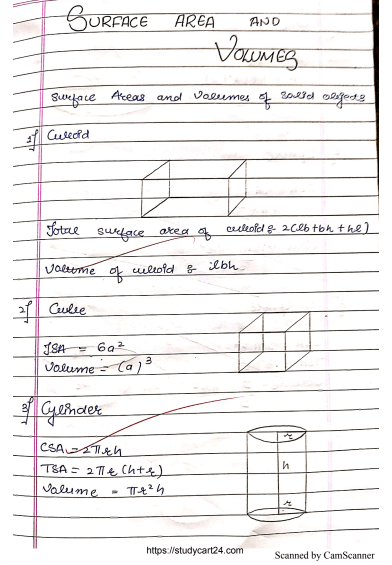
1. Cuboid
- Surface Area = 2(lb + bh + hl)
- Volume = l × b × h
2. Cube
- Surface Area = 6a^2
- Volume = a^3
3. Cylinder
- Curved Surface Area = 2πrh
- Total Surface Area = 2πr(h + r)
- Volume = πr^2h
4. Cone
- Curved Surface Area = πrl
- Total Surface Area = πr(l + r)
- Volume = (1/3)πr^2h
5. Sphere
- Surface Area = 4πr^2
- Volume = (4/3)πr^3
6. Hemisphere
- Curved Surface Area = 2πr^2
- Total Surface Area = 3πr^2
- Volume = (2/3)πr^3
7. Frustum of Cone
- Volume = (1/3)πh(r1^2 + r2^2 + r1r2)
- Curved Surface Area = π(r1 + r2)l
Previously Asked Questions from Board Exams – Chapter 13: Surface Areas and Volumes
- Find the surface area of a cone with radius 7 cm and slant height 25 cm.
- A well of diameter 14 m and depth 10 m is dug. Find the volume of the earth dug out.
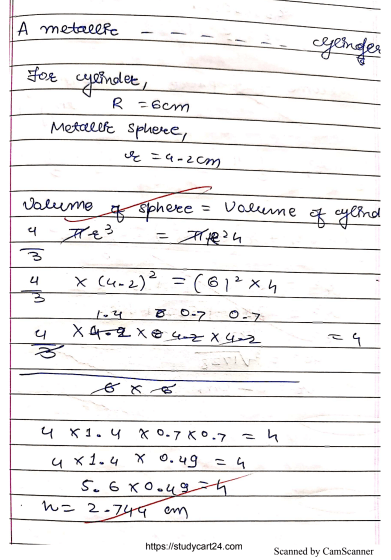
- A sphere and a cylinder have the same radius. If the height of the cylinder is twice the radius, compare their volumes.
- A toy is made by attaching a hemisphere to the top of a cylinder. If the height of the cylinder is 10 cm and the radius is 3.5 cm, find the total surface area.
- Convert a solid metal cylinder into a cone. What is the loss of material?
Expected Questions for Upcoming Exams
- Word problems based on combined solids.
- Comparative problems: sphere vs hemisphere, cube vs cuboid.
- Conversion questions: cone to frustum, cuboid to cylinder.
- Find the quantity of material used or wasted.
- Daily-use scenarios like painting tanks, digging wells, etc.
One-Liners with Answers
- CSA of a sphere? → 4πr^2
- Volume of a cone? → (1/3)πr^2h
- Which solid has the largest surface area to volume ratio? → Cube
- Volume of hemisphere? → (2/3)πr^3
- TSA of cylinder? → 2πr(h + r)
- Unit of Volume? → Cubic units (e.g., cm^3)
- Unit of Area? → Square units (e.g., cm^2)
FAQs
Yes, these notes cover all the concepts, derivations, formulas, and board-style questions you need.
On average, 4-5 marks are allocated to this chapter every year.
Yes, important exemplar problems are selectively included.
Absolutely. The 15-page structure is optimized for rapid and effective revision.
Formulas constitute 80% of the scoring potential, so memorizing them is critical.
Useful Tables From Chapter 13: Surface Areas and Volumes Class 10
Table 1: Shape and Corresponding Formulas
| Shape | CSA Formula | TSA Formula | Volume Formula |
|---|---|---|---|
| Cube | 6a^2 | 6a^2 | a^3 |
| Cuboid | 2(lb + bh + hl) | 2(lb + bh + hl) | l × b × h |
| Cylinder | 2πrh | 2πr(h + r) | πr^2h |
| Cone | πrl | πr(l + r) | (1/3)πr^2h |
| Sphere | 4πr^2 | 4πr^2 | (4/3)πr^3 |
| Hemisphere | 2πr^2 | 3πr^2 | (2/3)πr^3 |
| Frustum | π(r1 + r2)l | Add both bases & CSA | (1/3)πh(r1^2 + r2^2 + r1r2) |
Conclusion – Chapter 13: Surface Areas and Volumes
Chapter 13: Surface Areas and Volumes demands a clear understanding of geometric principles and confident application of formulas. These free handwritten notes serve as a comprehensive revision tool and guide. Whether you’re aiming for full marks or just trying to strengthen your grasp on Mensuration, these notes are a must-have. Don’t forget to download and go through the practice questions daily.
With the strategic use of our formula sheet, previously asked questions, and expected problems, you are all set to score high in this chapter. Let this be your go-to resource for mastering Class 10 Maths Chapter 13 effectively and efficiently.
Tags:
CBSE Board exam class 10,
NCERT class 10 Maths notes,
Download free class 10 notes,
class 10 Mathematics chapter 13,
Surface areas and volumes notes,
Free study materials for class 10,
class 10 board exam preparation,
studycart24.com class 10 resources,
Handwritten notes for surface areas and volumes,
chapter 13 surface areas and volumes handwritten free notes,
Surface areas and volumes formulas class 10,
NCERT solutions for surface areas and volumes,
Solved examples surface areas and volumes class 10,
Easy notes for surface areas and volumes,
Important questions surface areas and volumes class 10

