Chemical Bonding and Molecular Structure Class 11 Notes: Understanding the intricacies of chemical bonding and molecular structure is pivotal for students delving into Chapter 4 Class 11th Chemistry. This chapter lays the foundation for comprehending how atoms combine to form molecules, influencing the properties and behaviors of substances. To aid in mastering this essential topic, we present meticulously crafted handwritten notes, available for free download in PDF format.
 Join Telegram
 Join WhatsApp
- Subject: Chemistry
- Chapter: Chemical Bonding and Molecular Structure
- Size: 6 MB
- Total Pages: 42
- Language: English
- Format: PDF
- Download link: Scroll down below to find download link.
Features of Chemical Bonding and Molecular Structure Class 11 Handwritten Notes
Our handwritten notes are designed with the student’s needs in mind, offering a comprehensive and accessible resource for mastering chemical bonding and molecular structure. Key features include:
Clarity and Precision: Each concept is explained in straightforward language, ensuring easy comprehension.
Visual Aids: Incorporation of diagrams, tables, and charts to visually represent complex ideas, facilitating better understanding.
Structured Layout: Topics are organized systematically, following the NCERT curriculum, which aids in logical progression through the subject matter.
Emphasis on Key Points: Important definitions, formulas, and exceptions are highlighted to draw attention to critical information.
Practice Questions: A variety of questions, including multiple-choice, short answer, and long answer types, are provided to test comprehension and application of concepts.
Previous Exam Questions: Inclusion of questions from past examinations to familiarize students with the pattern and level of questions asked.
Conciseness: While comprehensive, the notes are concise enough to serve as a quick revision tool before exams.
Preview and Download Link of Chemical Bonding and Molecular Structure Class 11 Handwritten Notes PDF
Before downloading, you might want to preview the quality and layout of our notes. Below is a snapshot of what you can expect:

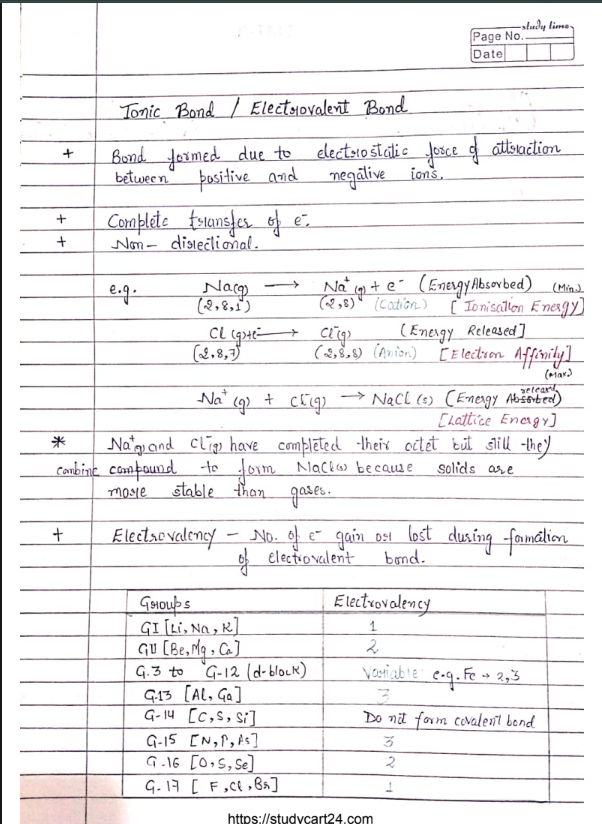
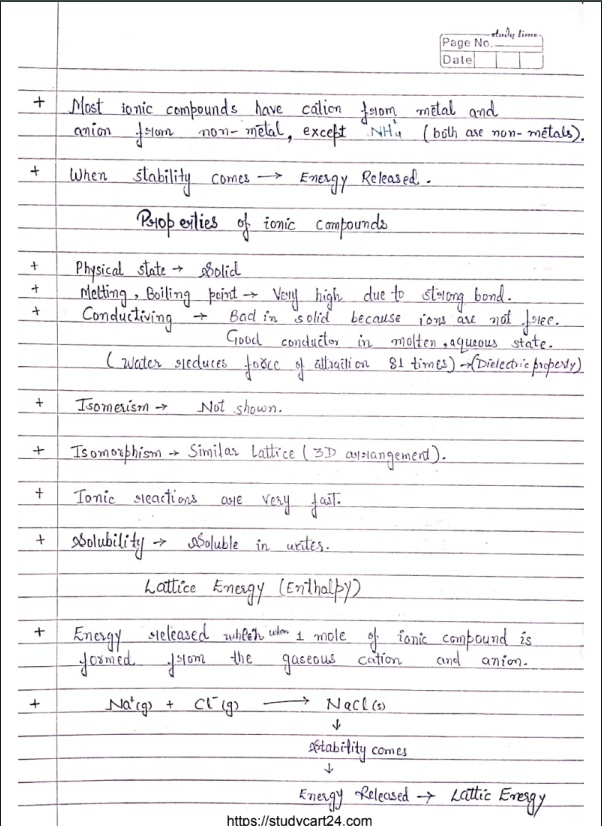
Images of Chapter 4 Chemistry Handwritten Notes PDF
To access the complete set of handwritten notes for Chapter 4: Chemical Bonding and Molecular Structure, click on the download link below:
Related Notes: Chapter 8 Organic Chemistry Class 11 Notes
Other Recommended Notes from AMAZON Related to Chemical Bonding and Molecular Structure Notes
Chemistry Class 11th Notes – Chemical Bonding
ONE SHOT Revision Notes Class 11th Chemistry
🙏 Support Our Work
We work very hard to create quality handwritten notes to support your learning journey. Every page is the result of hours of dedication and care. If you find our efforts valuable, please consider supporting us. Even a small contribution of ₹5, ₹10, ₹50, or ₹100 — whatever feels right to you — can make a big difference. Your support helps us continue this platform and keep the notes accessible to everyone. Donate securely via PhonePe – your kindness truly means a lot.

UPI ID:
(Tap to copy)
Please Donate ₹5, ₹10, ₹50, ₹100 or whatever feels right to you.
How to Prepare for Chapter 4 Chemistry
Preparing effectively for this chapter involves a strategic approach:
Begin with NCERT Textbook: Thoroughly read the NCERT textbook to build a strong conceptual foundation. Pay special attention to the examples provided.
Utilize Handwritten Notes: Use our handwritten notes to reinforce and clarify concepts. The simplified explanations and visual aids can help in better retention.
Practice Regularly: Solve the practice questions provided in the notes. Regular practice helps in identifying weak areas and improving problem-solving skills.
Revise Periodically: Regular revision is key to retaining information. Use their concise summaries in the notes for quick revisions.
Attempt Previous Year Questions: Familiarize yourself with the exam pattern by solving questions from past papers included in the notes.
Clarify Doubts Promptly: Do not let doubts accumulate. Seek clarification from teachers or peers to ensure a clear understanding of all topics.
Important Topics of Chemical Bonding and Molecular Structure Chapter
Focusing on the following key topics will enhance your understanding and performance:
Kossel-Lewis Approach to Chemical Bonding: Understanding the formation of ionic and covalent bonds based on electron transfer and sharing.
Ionic or Electrovalent Bond: Study of bond formation through electron transfer, characteristics of ionic compounds, and lattice energy.
Covalent Bond: Exploration of bond parameters, polarity, and the concept of resonance in covalent bonding.
Valence Shell Electron Pair Repulsion (VSEPR) Theory: Predicting molecular shapes based on electron pair repulsions.
Valence Bond Theory (VBT): Concept of hybridization and the formation of sigma and pi bonds.
Molecular Orbital Theory (MOT): Formation of molecular orbitals, bond order, and magnetic properties of molecules.
Hydrogen Bonding: Understanding the nature, types, and significance of hydrogen bonds in molecules.
Previously Asked Questions Of Chapter 4 Chemistry – Chemical Bonding and Molecular Structure
Question. Explain the non-linear shape of H2 S and the non-planar shape of PCl3 using valence shell electron pair repulsion theory.
Question. Explain the shape of BrF5.
Question. Why does the type of overlap given in the following figure does not result in formation of bond?
In both water and the dimethyl ether (CH3 —Ο — CH3 ), the oxygen atom is the central atom and having the same hybridisation, yet they have different bond angles. Which one has a greater bond angle? Elaborate with a reason.
Question. What is the ionic bond? With two suitable examples, explain the difference in between an ionic and the covalent bond?
FAQs on Chemical Bonding and Molecular Structure Class 11 Notes
A1: While these notes comprehensively cover Chapter 4, it’s advisable to refer to the NCERT textbook and solve various problems for thorough preparation.
A2: Regular revision is key. Aim to revisit the chapter weekly, focusing on different topics each time to reinforce learning.
A3: These notes provide a strong foundation, but for competitive exams, additional practice with higher-order problems and reference books is recommended.
A4: Regular revision is key. Aim to revisit the chapter weekly, focusing on different topics each time to reinforce learning.
Click this link to download Chapter 4 Chemical Bonding and Molecular Structure.
Tags: Class 11 Chemistry Chapter 4 Chemical Bonding and Molecular Structure Notes,
Chemistry Handwritten Notes PDF,
Class 11 Chemistry Handwritten Notes PDF,
Class 11 Chapter 4 Chemical Bonding and Molecular Structure Notes,
Download Chemistry Class 11 NCERT Notes,
Class 11 Chemistry Chapter Wise Notes PDF,
Free Notes for Chemistry Class 11,
Chemical Bonding and Molecular Structure Class 11 Notes,
Class 11 Chemistry chemical bonding and Molecular Structure Notes PDF,
Chemical bonding and molecular structure class 11 notes pdf,
Chemical bonding and Molecular Structure Class 11 PDF,
Chemical Bonding and Molecular Structure Class 11 handwritten notes,
Class 11 Chemistry Chapter 4 Notes PDF download,
Chemical Bonding Class 11,